$32.2 billion.
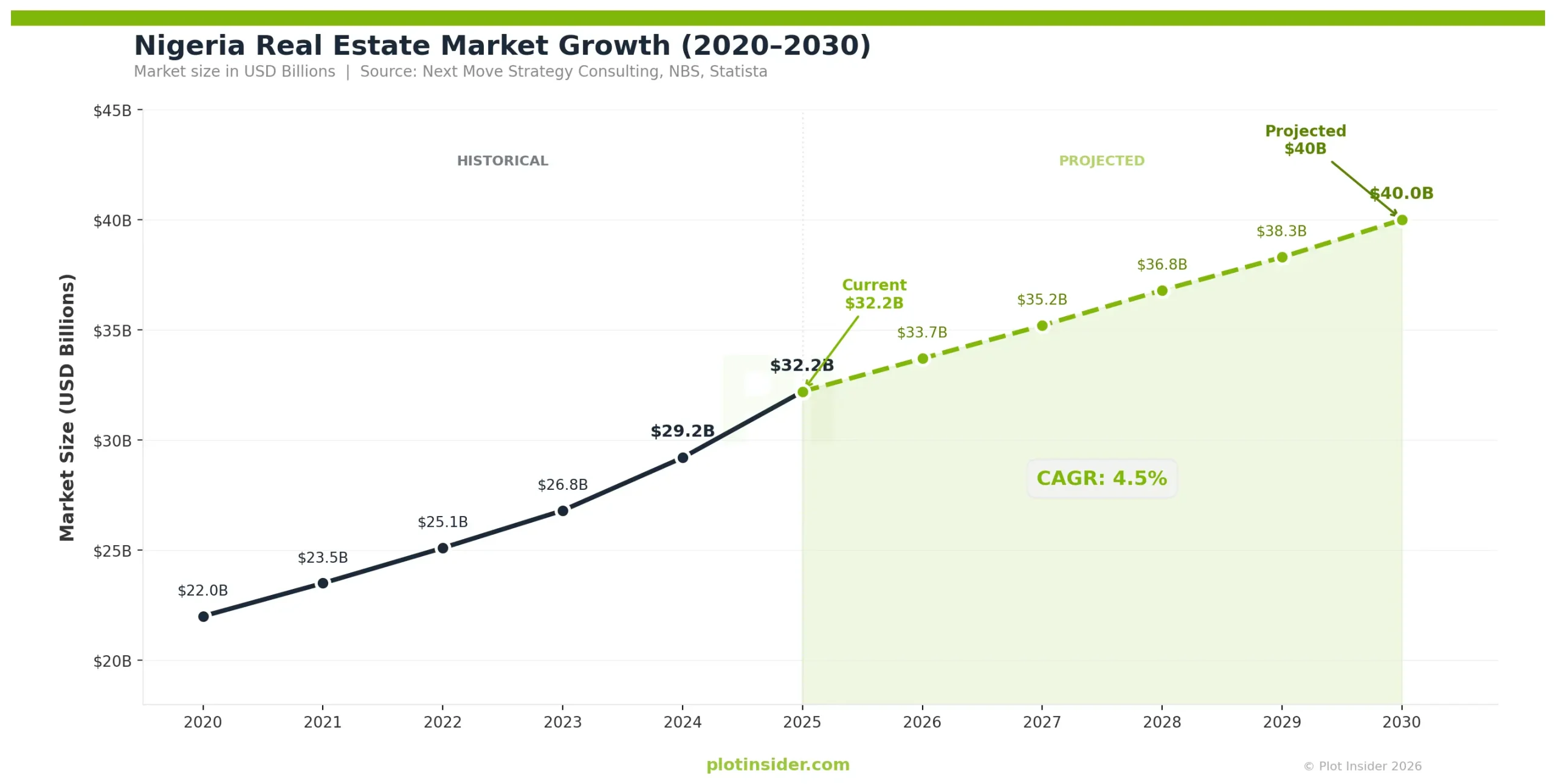
That’s the current size of Nigeria’s real estate market, according to a 2026 report by Next Move Strategy Consulting. Yet most Nigerians entering this market — whether as first-time buyers, investors, or agents — don’t fully understand how real estate actually works as a system.
This guide breaks down the mechanics of real estate from the ground up. No jargon, no assumptions. Just data-backed explanations of how property is bought, sold, rented, and developed in Nigeria and globally.
If you’ve ever asked “how does real estate work?” and received a vague answer, this article is your definitive reference.
Key Takeaways
- Real estate works through four core activities: buying, selling, renting, and developing property — each with distinct cash flow mechanics.
- Nigeria’s real estate market is valued at $32.2 billion in 2025 and projected to reach $40 billion by 2030, growing at 4.5% CAGR.
- The country has a housing deficit of over 22 million units, meaning demand outpaces supply by a massive margin — creating sustained investment opportunity.
- Residential real estate dominates the Nigerian market at $2.25 trillion in projected value, but commercial and land segments are growing fastest in cities like Lagos, Abuja, and Port Harcourt.
- Understanding how real estate transactions work — from title verification to closing costs — protects you from the fraud and disputes that account for over 30% of civil cases in Nigerian courts.
What Is Real Estate?
Real estate refers to land, the physical structures built on it, and the natural resources attached to it. This includes residential homes, commercial office buildings, industrial warehouses, agricultural farmland, and undeveloped plots.
In economic terms, real estate is a tangible asset class — meaning it has physical form, unlike stocks or bonds. Its value is driven by location, demand, infrastructure, and government policy.
Nigeria’s real estate sector contributed 5.4% to GDP in Q3 2024, according to the National Bureau of Statistics. That makes it one of the largest non-oil sectors in the economy.
The 4 Ways Real Estate Works as an Investment
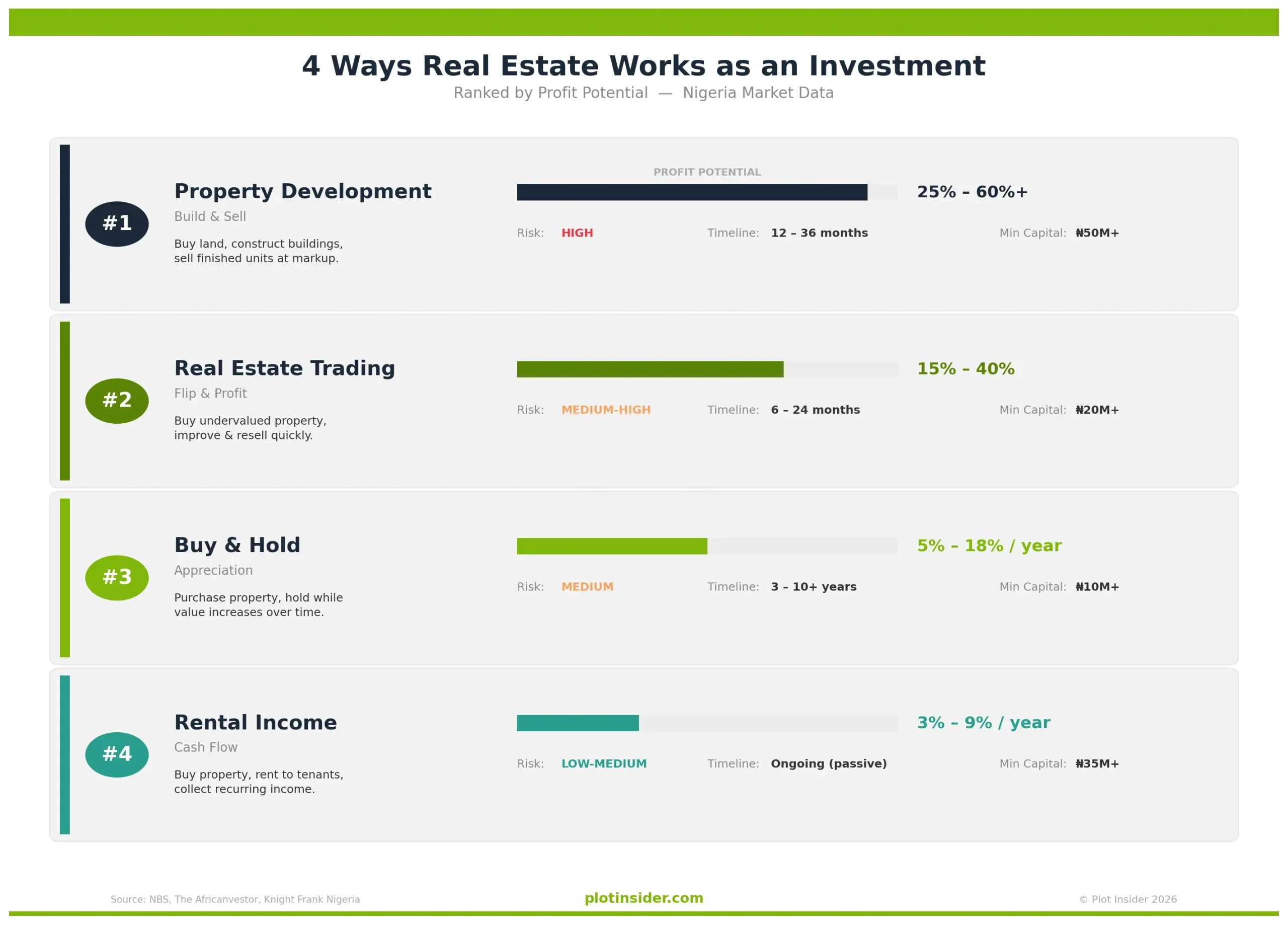
Real estate generates wealth through four distinct mechanisms. Understanding each one is critical before you commit your capital.
1. Buying and Holding (Appreciation)
You buy a property and hold it while its value increases over time. This is the most common real estate strategy in Nigeria.
According to data from The Africanvestor, Nigerian property prices rose approximately 18% in naira terms from January 2025 to January 2026. Over a 10-year period (2016–2026), cumulative price growth in Lagos reached roughly 300% in nominal naira terms.
However, after adjusting for inflation, real growth was closer to 35%–60%. This is an important distinction — rising prices don’t always mean rising wealth if the naira is losing purchasing power simultaneously.
2. Rental Income (Cash Flow)
You buy a property and rent it out to tenants. The rent you collect, minus expenses (maintenance, management, taxes), is your net cash flow.
Rental yields in Nigeria vary significantly by location. In emerging areas like Ajah and Yaba, gross rental yields range from 6% to 8% annually, according to market analysis from The Africanvestor. In prime areas like Lekki and Ikoyi, yields are lower — typically 3% to 5% — because property prices are higher relative to rental income.
3. Property Development (Value Creation)
You buy land, construct a building, and sell or rent the finished units at a significant markup above total costs. This is the highest-risk, highest-return approach.
Development profits in Nigerian urban markets can range from 25% to 60% depending on location, construction costs, and market timing. But rising material costs — driven by naira depreciation and import dependency — have squeezed margins since 2023.
4. Real Estate Trading (Flipping)
You buy an undervalued property, improve it (renovate, repurpose, or simply wait for market appreciation), and sell it at a profit within a short timeframe — typically 6 to 24 months.
Flipping is less common in Nigeria than in the US market because of high transaction costs (stamp duties, legal fees, and agency commissions can add 10%–18% to any deal). This means your margin must be substantial to justify the strategy.
How a Real Estate Transaction Works: Step by Step
Whether you’re buying land in Lekki or a flat in Abuja, every real estate transaction follows a similar sequence. Here’s how it works in Nigeria.
Step 1: Property Search and Due Diligence
You identify a property through an agent, platform (like PropertyPro or Nigeria Property Centre), or direct contact with the owner. Before making any payment, you conduct due diligence:
- Title verification — Confirm the seller has a valid Certificate of Occupancy (C of O), Governor’s Consent, or Deed of Assignment.
- Survey plan check — Cross-reference the physical plot dimensions with the official survey plan at the state Surveyor General’s office.
- Encumbrance search — Check for existing liens, court orders, or competing claims on the property.
Skipping this step is the single biggest cause of real estate fraud in Nigeria. Data from the Nigerian courts shows that land disputes account for over 30% of all civil litigation.
Step 2: Offer and Negotiation
Once due diligence clears, you make an offer. In Nigeria, prices are almost always negotiable — particularly for land and secondary-market properties.
Industry convention suggests offering 10%–15% below asking price as a starting point, though premium estates and new developments may have fixed pricing.
Step 3: Legal Documentation
A real estate lawyer drafts or reviews the key documents:
- Offer Letter / Letter of Intent — formalizes your interest and agreed price.
- Deed of Assignment — legally transfers ownership from seller to buyer.
- Receipt of Purchase — proof of payment.
- Power of Attorney — if someone else is acting on your behalf.
Legal fees typically range from 5%–10% of the property value, depending on complexity and location.
Step 4: Payment
Most Nigerian real estate transactions are cash-based. According to Central Bank of Nigeria data, mortgage penetration in Nigeria is below 1% of GDP — compared to 50%+ in developed markets like the US and UK.
This means the overwhelming majority of buyers pay in full upfront or through installment plans directly with developers. Mortgages, where available, carry interest rates of 15%–25% annually, making them prohibitively expensive for most buyers.
Step 5: Transfer and Registration
After payment, the property is formally transferred. You register the transaction with the relevant state Land Registry. Registration costs include:
- Stamp duty — typically 1.5%–3% of property value.
- Registration fee — varies by state (₦50,000–₦250,000 in Lagos).
- Consent fee — required for Governor’s Consent processing (Lagos charges 3% of property value).
The entire process, from initial documentation to receiving your registered title, can take 3–12 months depending on the state.
Key Players in Real Estate
Real estate doesn’t work in isolation. It’s an ecosystem of interconnected professionals.
Real Estate Agents / Brokers — connect buyers and sellers, typically earning 5%–10% commission on sales and 10% of annual rent on leasing deals.
Property Developers — acquire land, build structures, and sell or manage the finished product. Major Nigerian developers include Adron Homes, Mixta Real Estate, and UPDC Plc.
Surveyors — conduct land measurement, valuation, and boundary verification. Licensed by the Surveyors Council of Nigeria (SURCON).
Estate Valuers — assess property market value for sales, mortgages, and insurance. Regulated by the Nigerian Institution of Estate Surveyors and Valuers (NIESV).
Lawyers — handle title searches, contract drafting, and dispute resolution.
Government Agencies — Land Registries, AGIS (Abuja), LASPPPA (Lagos), and Federal Housing Authority all regulate land use, planning approvals, and title issuance.
Top 5 Real Estate Booming States in Nigeria
Not all Nigerian states are equal when it comes to property investment. The data reveals five clear leaders driving the country’s real estate growth in 2026.
1. Lagos State
Lagos is Nigeria’s undisputed real estate capital. Property prices surged 39.5% in 2024 alone, according to The Africanvestor. The state accounts for the highest volume of real estate transactions in the country, driven by a population exceeding 21 million, the Eko Atlantic City mega-project, and infrastructure investments like the Fourth Mainland Bridge and Lagos-Calabar Coastal Road.
Entry prices range from ₦35 million for a 2-bedroom flat in Ajah to over ₦3 billion in Banana Island. Rental yields vary from 3% in premium island locations to 9% in emerging suburbs.
2. Federal Capital Territory (Abuja)
Abuja recorded 10%–15% property price increases in 2024–2025, with high-end residential demand concentrated in Asokoro, Maitama, and Wuse 2. Growth corridors like Lugbe, Karsana, and Katampe Extension are attracting mid-market investors priced out of the city center.
The FCT’s structured planning system through AGIS provides more documentation clarity than most states, making it attractive to cautious investors.
3. Ogun State
Ogun State posted 30.5% property price growth in 2024, second only to Lagos. Its proximity to Lagos — combined with significantly lower land prices — makes it a magnet for overflow demand. Areas near industrial hubs are seeing 18% annual land appreciation.
The Lagos-Ibadan Expressway expansion and new industrial corridors are accelerating this growth.
4. Rivers State (Port Harcourt)
Port Harcourt is Nigeria’s oil capital and the third-largest real estate market. A 6% increase in property prices was forecast for 2025, with stable demand for high-end residential properties driven by the oil and gas industry.
The Trans-Amadi industrial corridor and GRA Phase 2 remain the primary investment zones.
5. Oyo State (Ibadan)
Ibadan is emerging as a real estate dark horse. Land appreciation is running at 15% annually due to urban expansion, according to MKH Properties. The city benefits from the Lagos-Ibadan Expressway, lower cost of living, and growing institutional presence — including the University of Ibadan and multiple tech hubs.
Peri-urban areas around Ibadan are attracting investors seeking affordable entry points with long-term upside.
Top 5 Real Estate Countries in Africa
Africa’s real estate market reached $233.51 billion in 2025, according to Market Data Forecast, and is projected to hit $347.31 billion by 2034 at a 4.51% CAGR. Five countries dominate the continent’s property landscape.
1. Nigeria — $32.2 Billion (2025)
Nigeria leads Sub-Saharan Africa in real estate market size. A housing deficit of 22–28 million units, a population exceeding 230 million, and rapid urbanization (over 51% urban) create sustained demand. Lagos and Abuja remain the primary investment hubs, with 5%–15% annual price growth forecast through 2026.
2. South Africa — $21.97 Billion (Residential Alone, 2025)
South Africa has the continent’s most mature and transparent property market. Cape Town leads price growth, commanding 23.4% of residential value in 2025. The country benefits from established mortgage infrastructure, REIT frameworks, and strong rule of law. Rental yields in prime Cape Town and Johannesburg range from 4%–7%.
3. Egypt — Large-Scale Growth Market
Egypt offers sheer scale with its large population and expanding middle class. Mega-developments along the Red Sea and the New Administrative Capital east of Cairo are driving commercial and residential growth. Currency volatility remains a risk, but for investors comfortable with complexity, Egypt presents value opportunities at price points below international resort markets.
4. Kenya — East Africa’s Real Estate Hub
Nairobi is often called the “Silicon Savannah” — home to regional offices for Microsoft, Google, and dozens of multinational companies. Kenya’s GDP is projected to grow 5.2% annually through 2026, driving demand for both commercial office space and mid-tier housing. Rental yields in Nairobi range from 6%–12%, among the highest on the continent.
5. Ghana — Stable Market, Rising Returns
Ghana stands out for political stability, favorable economic policies, and a growing urban population. Accra and Kumasi are attracting both local and diaspora investment. The government’s infrastructure initiatives and relatively transparent land registration make it one of West Africa’s most investor-friendly markets outside Nigeria.
| Country | Market Size (2025) | Key City | Annual Growth | Rental Yield Range |
|---|---|---|---|---|
| Nigeria | $32.2B | Lagos | 5%–15% | 3%–9% |
| South Africa | $21.97B (residential) | Cape Town | 3%–5% (real) | 4%–7% |
| Egypt | Large-scale | Cairo | 8%–12% | 5%–8% |
| Kenya | Growing | Nairobi | 5%–8% | 6%–12% |
| Ghana | Emerging | Accra | 6%–10% | 5%–8% |
Common Mistakes Beginners Make in Nigerian Real Estate
Three errors cost beginners the most money and time.
Buying without verifying the title. A property can look perfect physically but be legally compromised — government-acquired land, family land with multiple claimants, or forged C of O documents are all common traps. Always verify at the state land registry before paying.
Ignoring total transaction costs. The listed price is never the final cost. Factor in legal fees (5%–10%), agency commission (5%–10%), stamp duty (1.5%–3%), registration, survey, and potential renovation. A ₦50 million property can easily cost ₦60–65 million all-in.
Choosing location based on price alone. Cheap land in a flood-prone area or a neighborhood with no road access will appreciate slowly — if at all. Infrastructure, drainage, road quality, and proximity to economic activity are what drive long-term value.
Conclusion
Real estate works as a system — buying, selling, renting, and developing property within a framework of legal documentation, professional expertise, and market data. In Nigeria, where the market is valued at over $32 billion and growing, the opportunity is enormous. But so are the risks.
The difference between successful real estate participants and everyone else is data. Knowing the real prices, understanding transaction costs, verifying titles, and tracking infrastructure development — this is what separates informed decisions from expensive mistakes.
Plot Insider was built to give you exactly this kind of intelligence. Bookmark our homepage for data-driven real estate, climate, and geographic analysis that helps you make better decisions about land and property.
FAQs
How does real estate make money?
Real estate generates income through four primary mechanisms: property appreciation (value increases over time), rental income (cash flow from tenants), development profits (building and selling at a markup), and trading/flipping (buying undervalued property, improving it, and reselling). In Nigeria, appreciation and rental income are the most common strategies, with rental yields averaging 3%–8% depending on location.
Is real estate a good investment in Nigeria?
Nigeria’s real estate market has grown from $29.2 billion in 2024 to $32.2 billion in 2025, with projections reaching $40 billion by 2030. The country’s housing deficit of 22 million units creates sustained demand. However, high transaction costs, currency risk, and limited mortgage access make it essential to invest with verified data and professional guidance.
How long does it take to complete a real estate transaction in Nigeria?
A typical Nigerian real estate transaction takes 3 to 12 months from initial negotiation to registered title transfer. The timeline depends on the state (Lagos and Abuja tend to be faster with digitized registries), whether Governor’s Consent is required, and the complexity of the title history. Cash transactions close faster than the rare mortgage-financed deals.
What documents do I need to buy property in Nigeria?
The essential documents are: Certificate of Occupancy (C of O) or Governor’s Consent from the seller, a survey plan verified with the state Surveyor General, Deed of Assignment prepared by a real estate lawyer, and proof of payment (receipt). Additionally, you should conduct an encumbrance search at the land registry to confirm no competing claims exist.
Sources
- Next Move Strategy Consulting — Nigeria Real Estate Market Report, 2026
- National Bureau of Statistics (NBS) — Real Estate Sector GDP Contribution, Q3 2024
- Statista — Nigeria Real Estate Market Forecast, 2025–2029
- The Africanvestor — Nigeria Real Estate Market Statistics, 2026
- Central Bank of Nigeria — Mortgage and Housing Finance Data, 2025