
24% vs 7%. That’s the yield spread between Lagos short-let operations (Q1 2026 net yield, per Nigeria Real Estate Blog) and Abuja’s best rental market in Maitama (gross yield, per The Africanvestor). Same country, same currency — completely different ROI mathematics.
Pick Lagos because “everyone says Lagos” and you might buy into a prime Ikoyi apartment yielding 3% gross. Pick Abuja because “it’s the capital” and you might deploy ₦5 billion into a Maitama compound where liquidity on exit is thin. The question isn’t which city is “better” — it’s which city is better for your specific strategy, capital, and time horizon.
Key Takeaways
- Lagos short-let operations win on absolute yield — 24% net in Q1 2026 vs Abuja’s typical 6–8% for Airbnb-grade properties
- Abuja Maitama wins on traditional rental yield — ~7% gross, the highest of any Nigerian prime district
- Lagos growth corridors win on appreciation — Ibeju-Lekki at 20–25% annually vs Abuja’s 12–18% in Guzape
- Abuja delivers more price stability (embassy and government demand is recession-resistant)
- Lagos requires more capital at the prime tier (Banana Island ₦1.5B–7B vs Maitama ₦800M–30B with thinner transaction volume)
- Median prices: Lagos ₦230M vs Abuja ~₦330M for houses, ~₦125M for flats
The ROI Question: Why It Depends On Your Strategy
Lagos and Abuja are structurally different real estate markets. Lagos is commercial-driven, with banking, tech, oil, and entertainment capital fueling demand. Abuja is government-driven, with political, diplomatic, and civil-service demand shaping the market.
These different demand engines produce different ROI profiles across the five main real estate investment strategies.
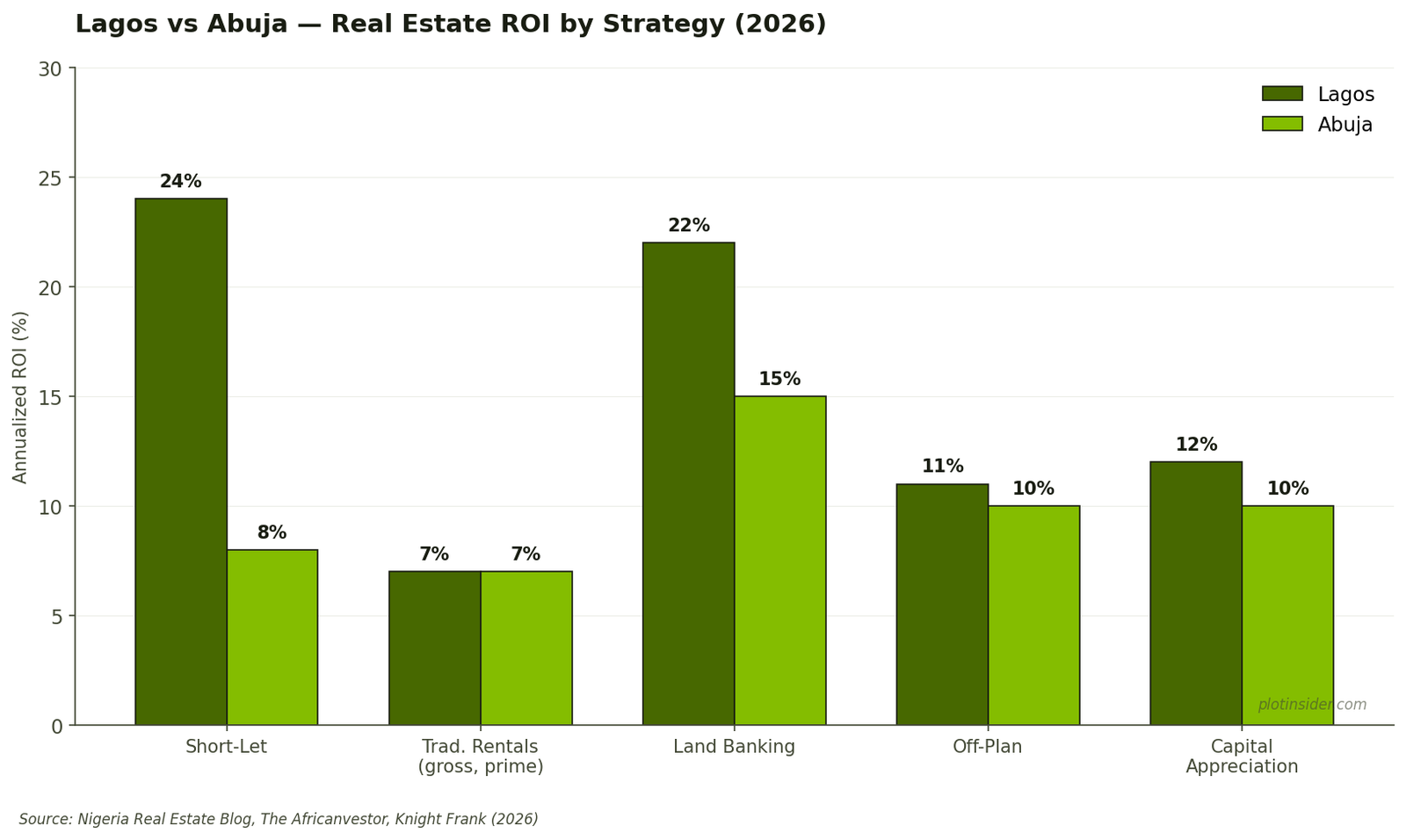
| Strategy | Lagos ROI | Abuja ROI | Winner |
|---|---|---|---|
| Short-let operations | 24% net (Q1 2026) | 6–10% net | Lagos |
| Traditional rentals (gross) | 6–8% | 7% (Maitama) | Abuja (prime only) |
| Land banking | 20–25% (Ibeju-Lekki) | 12–18% (Guzape) | Lagos |
| Off-plan property | 8–14% annualized | 8–12% annualized | Lagos (slightly) |
| Capital appreciation (prime) | 10–15% | 8–12% | Lagos |
Data compiled from our Plot Insider Team research Data, The Africanvestor, Knight Frank Nigeria, and Nigeria Housing Market, 2026.
Deep Dive: Rental Yield Comparison
Lagos Rental Yields 2026
According to The Africanvestor’s February 2026 update:
| Lagos Apartment Type | Gross Yield |
|---|---|
| Studio (thin market) | 5–7% |
| 1-bedroom | 3–4% |
| 2-bedroom (sweet spot) | 4–6% |
| 3-bedroom | 4–5% |
Net yields after management (10–15%) and 10% withholding tax typically fall to 4–6% for well-managed properties. Ultra-prime areas (Banana Island, Old Ikoyi) compress yields below 5% because purchase prices have outrun rent growth.
Abuja Rental Yields 2026
Per The Africanvestor’s Abuja analysis:
| Abuja District | Gross Yield |
|---|---|
| Maitama | ~7% (highest in Abuja) |
| Gwarinpa | ~4.4% |
| Guzape / Lokogoma | 3.3–3.4% |
| Wuse II (apartments) | 2–3% |
| Jabi (lifestyle) | 2–3% |
Maitama’s 7% yield is the highest gross rental yield of any Nigerian prime district — higher than Banana Island Lagos, higher than Ikoyi, higher than any Abuja district. The driver is consistent embassy and NGO tenant demand willing to pay premium rents for diplomatic-grade housing.
Verdict on Rentals
If you want traditional rental yields at the prime tier, Maitama Abuja wins. At 7% gross (approximately 5% net after fees and tax), Maitama outperforms every Lagos prime district.
If you want mid-market rental yields, Lagos wins on neighborhood diversity. Yaba, Ikeja GRA, and Magodo Phase 2 all deliver 5–8% gross yields with a broader tenant base than any Abuja mid-market district.
Deep Dive: Short-Let ROI Comparison
Lagos Short-Let Market
Nigeria Real Estate Blog’s Q1 2026 analysis:
- Lagos average net yield: 24%
- Prime zones (Lekki Phase 1): 26–32% net
- Occupancy requirement: 60–75%
- Daily rates: ₦40k–₦150k
Lagos short-lets benefit from:
- High international business travel (Victoria Island)
- Entertainment industry (Lekki/Ikoyi)
- Tech conferences (mainland, VI)
- Wedding and event traffic
- Weekend tourism and staycations
Abuja Short-Let Market
Abuja short-lets generate:
- Monthly revenue per property: ₦600k–₦1.2M (per The Africanvestor 2026 data)
- Net yields: 6–10% on purchase price
- Top zones: Wuse II (corporate), Maitama (embassy), Jabi (lifestyle), Utako (mid-priced)
Abuja short-lets depend heavily on government-cycle demand (corporate visitors, contractors, NGO professionals). Demand is steadier than Lagos but smaller in absolute volume.
Verdict on Short-Lets
Lagos wins decisively on short-let ROI. 24% net yield vs 6–10% isn’t close. The Lagos short-let market is larger, more diverse, and benefits from multiple demand engines (business, entertainment, tourism, events).
However, Lagos short-lets require active management, reliable power backup, professional photography, and dynamic pricing. Done poorly, yields collapse below buy-and-hold levels.
Deep Dive: Capital Appreciation Comparison
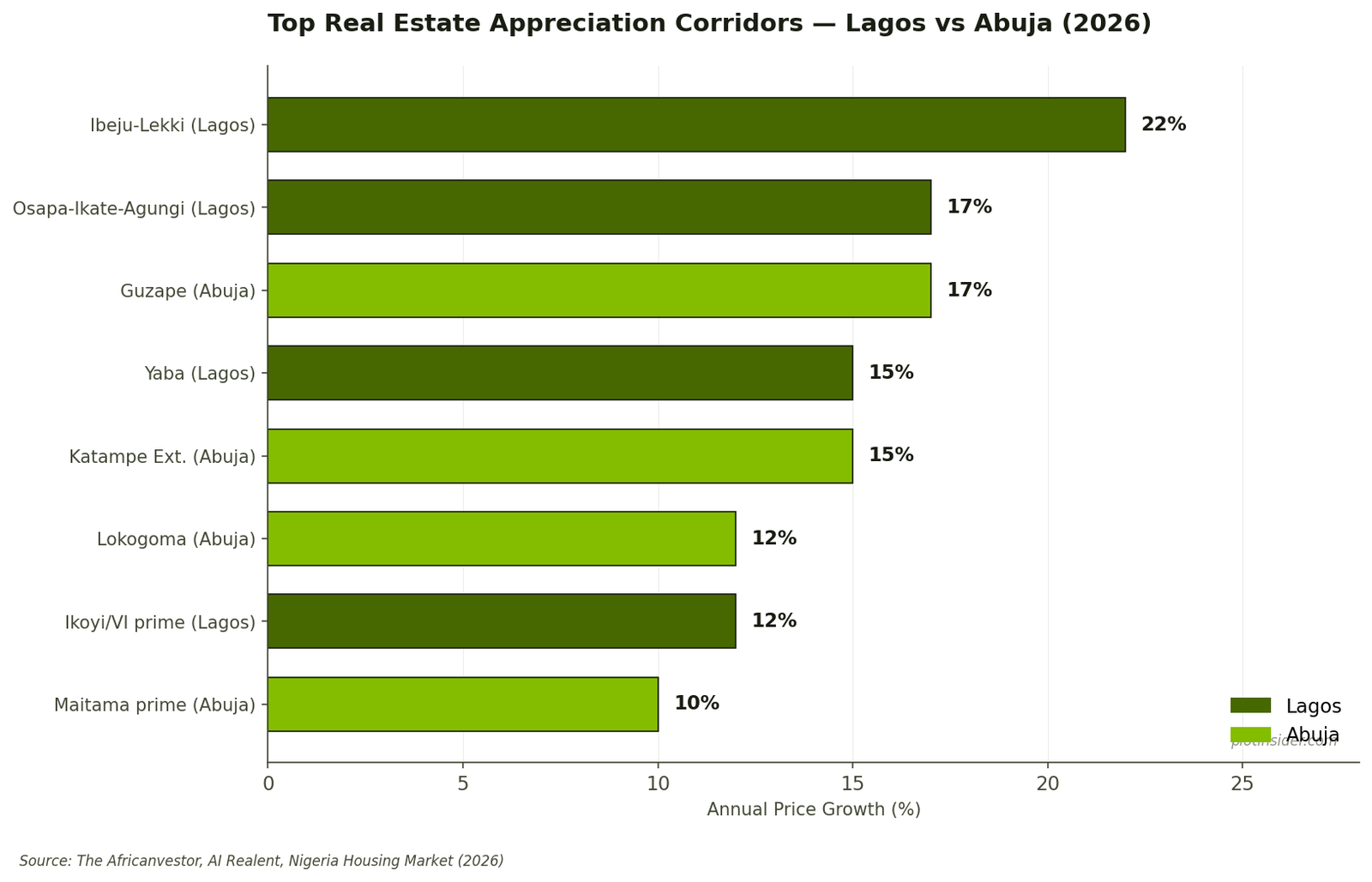
Lagos Appreciation Leaders (2026)
Per The Africanvestor’s property price forecast:
| Lagos Area | Annual Price Growth |
|---|---|
| Ibeju-Lekki | 20–25% (Lekki Deep Sea Port catalyst) |
| Osapa London – Ikate – Agungi | 15–20% |
| Yaba | 12–18% (Red Line rail catalyst) |
| Prime (Ikoyi, VI, Banana Island) | 10–15% |
| Ajah and outer Lekki | 8–12% |
Abuja Appreciation Leaders (2026)
Per AI Realent and Nigeria Housing Market:
| Abuja District | Annual Price Growth |
|---|---|
| Guzape | 15–20% (fastest FCT growth) |
| Katampe Extension | 12–18% |
| Lokogoma, Kubwa | 10–15% |
| Maitama, Asokoro (prime) | 8–12% |
| Gwarinpa | 6–10% |
Verdict on Capital Appreciation
Lagos wins on absolute appreciation upside. Ibeju-Lekki’s 20–25% annual growth outpaces every Abuja district. For buyers specifically seeking capital appreciation, Lagos growth corridors deliver faster.
Abuja wins on appreciation stability. FCT master planning caps residential land per district, which means no oversupply shocks. Abuja prime appreciation is slower but more predictable.
Entry Capital Comparison
Median Entry Prices (2026)
| Segment | Lagos | Abuja |
|---|---|---|
| Median flat | ~₦230M | ~₦125M |
| Median house | ~₦230M+ | ~₦330M |
| Entry-level 2BR | ₦40–80M (Ajah, outer Lekki) | ₦35–70M (Lugbe, Lokogoma) |
| Mid-market 3BR | ₦100–200M | ₦80–200M |
| Prime apartment | ₦400M–₦1B (Ikoyi) | ₦200M–₦700M (Wuse II) |
| Ultra-prime | ₦1.5B–₦7B (Banana Island) | ₦800M–₦30B (Maitama) |
Data from Nigeria Property Centre, PropertyPro, The Africanvestor, 2026.
Verdict on Entry Capital
Abuja is more capital-accessible at the mid-market tier. A ₦125M flat in Abuja mid-market is comparable to a ₦180–230M equivalent in Lagos.
Lagos offers more inventory at every price point — the transaction volume is roughly 3–4x Abuja’s, which means more choice and faster exits.
Abuja’s ultra-prime has the highest absolute ceiling (Maitama mega-compounds at ₦30 billion) but with thinner buyer pools. Exit liquidity at ₦10B+ is slower than equivalent Lagos prime.
Liquidity and Exit Comparison
Lagos Market Liquidity
Lagos’s scale advantage matters more than headline prices. Transaction volume is approximately 3x Abuja’s. For investors who may need to exit, Lagos offers:
- More active agents and agencies
- Larger buyer pool at every price point
- More diaspora buyer activity
- Faster sale cycles (30–90 days for well-priced properties)
Abuja Market Liquidity
Abuja’s smaller market has trade-offs:
- Fewer transactions overall
- Thinner buyer pools at ultra-prime
- Strong demand at Maitama/Asokoro (embassies + government)
- Moderate demand at mid-market (government workers, civil servants)
- Over 4,600 active PropertyPro listings as of early 2026 — suggesting buyer-favoring dynamics at mid-market
Verdict on Liquidity
Lagos wins decisively on liquidity. If exit flexibility matters to your strategy, Lagos is the safer bet.
Abuja offers stronger demand at the prime tier (embassies, NGOs, government) but slower absolute turnover.
Verdict by Investor Profile
Different investors should choose different cities. Here’s the mapping:
Profile 1: Passive Rental Income Investor (₦100M–₦500M)
Winner: Abuja (Maitama)
7% gross yield at Maitama outperforms any Lagos prime district. Embassy tenant demand is recession-resistant. Perfect for passive buy-and-hold.
Profile 2: Active Short-Let Operator (₦30M–₦100M)
Winner: Lagos (Lekki Phase 1, VI, Ikoyi)
24% net yield in Lagos vs 6–10% in Abuja makes this a clear Lagos play. Lagos’s diverse demand engines (business, entertainment, tourism) produce higher average occupancy.
Profile 3: Capital Appreciation Speculator (₦3M–₦50M)
Winner: Lagos (Ibeju-Lekki)
20–25% annual appreciation with the Lekki Deep Sea Port catalyst beats any Abuja corridor. Higher risk, higher upside.
Profile 4: Ultra-High-Net-Worth Trophy Buyer (₦2B+)
Winner: Depends on social network
Lagos if your network is commercial/corporate (Banana Island, Ikoyi). Abuja if your network is political/diplomatic (Maitama, Asokoro). These are lifestyle purchases more than ROI plays.
Profile 5: Diaspora First-Time Investor (₦50M–₦150M)
Winner: Lagos (Lekki Phase 1 or Magodo Phase 2)
Better liquidity, more agents to work with remotely, larger buyer pool on exit. Abuja has merit but remote property management is harder with fewer established operators.
Common Mistakes in the Lagos vs Abuja Decision
Three mistakes recur when investors pick between these two cities.
Choosing based on prestige rather than strategy. Maitama is glamorous, but if your goal is short-let income, Lekki Phase 1 triples your yield. Don’t buy a neighborhood’s reputation — buy its numbers.
Ignoring infrastructure catalysts. Ibeju-Lekki’s 20–25% growth isn’t random — it’s tied to the Lekki Deep Sea Port. Guzape’s 15–20% growth is tied to Abuja’s master plan constraints. Always identify the specific catalyst behind the expected appreciation.
Underestimating active management costs in Lagos. Lagos short-let yields of 24% assume professional management, reliable power, and dynamic pricing. Absent those, yields fall to 10–12% — closer to Abuja’s numbers, but without Abuja’s stability.
For granular data on property prices across Nigeria, see our state-by-state plot of land price index. For broader context, our analysis of 23% of Lagos property searches starting in Ajah shows how even entry-level Lagos markets are shifting.
Conclusion: The Real Answer Is Strategy-Dependent
Lagos vs Abuja isn’t a question with a single answer. It’s a question that has five answers, depending on your strategy, capital, and time horizon.
If you want the single highest ROI play in Nigeria: Lagos short-lets at 24% net yield.
If you want the highest traditional rental yield in Nigeria: Abuja Maitama at 7% gross.
If you want the fastest capital appreciation: Lagos Ibeju-Lekki at 20–25% annually.
If you want the most liquid market: Lagos across almost every tier.
If you want the most stable market: Abuja prime (Maitama, Asokoro).
The worst decision is picking a city based on sentiment. The best decision is picking the strategy first, then picking the city that maximizes that strategy’s return.
At Plot Insider, we track Lagos and Abuja real estate markets every quarter — yields, transaction volumes, appreciation rates, and infrastructure catalysts. Bookmark us for the data-driven view of where Nigerian real estate capital actually performs hardest.
Frequently Asked Questions
Which city has better real estate ROI, Lagos or Abuja?
Neither city wins outright — it depends on your strategy. Lagos delivers higher short-let yields (24% net in Q1 2026 vs 6–10% in Abuja) and faster capital appreciation in growth corridors like Ibeju-Lekki (20–25% annually). Abuja wins on traditional rental yields, with Maitama at ~7% gross — the highest of any Nigerian prime district. Choose Lagos for active income and appreciation; choose Abuja for passive rental income.
Why does Lagos have higher short-let yields than Abuja?
Lagos has multiple demand engines for short-let accommodation: international business travelers (Victoria Island), entertainment industry (Lekki/Ikoyi), tech conferences, weddings and events, and weekend tourism. Abuja’s short-let market relies primarily on government-cycle corporate visitors and NGO professionals. This demand diversity allows Lagos to maintain 60–75% occupancy with higher daily rates.
Is it cheaper to invest in Abuja than Lagos?
Abuja mid-market entry is cheaper than Lagos mid-market. Median flat prices are ~₦125M in Abuja vs ~₦230M in Lagos. However, Abuja houses (median ~₦330M) can actually be more expensive than Lagos houses due to the FCT’s plot-size tradition. At ultra-prime levels, Abuja’s Maitama (₦800M–30B) spans a wider range than Lagos’s Banana Island (₦1.5B–7B).
Which Lagos or Abuja neighborhood has the highest rental yield?
Maitama in Abuja has the highest gross rental yield of any Nigerian prime district at approximately 7%, driven by consistent embassy and NGO tenant demand. Within Lagos, Yaba, Ikeja GRA, and Magodo Phase 2 deliver 5–8% gross yields. Lagos short-let operations in Lekki Phase 1 produce the highest absolute yield at 26–32% net — but require active management.
Sources
- Lagos Short-Let Yields Hit 24% in Q1 2026 — Nigeria Real Estate Blog. https://nigeriarealestateblog.com/lagos-short-let-yields-q1-2026/
- Lagos Rental Yields Data (2026) — The Africanvestor. https://theafricanvestor.com/blogs/news/lagos-nigeria-rental-yields
- Best Areas to Buy Property in Abuja (2026) — The Africanvestor. https://theafricanvestor.com/blogs/news/abuja-which-area
- Property Price Forecasts Lagos (2026) — The Africanvestor. https://theafricanvestor.com/blogs/news/lagos-nigeria-price-forecasts
- Nigeria Real Estate Forecast 2026 — Nigeria Housing Market. https://www.nigeriahousingmarket.com/market-forecasts/nigeria-real-estate-2026