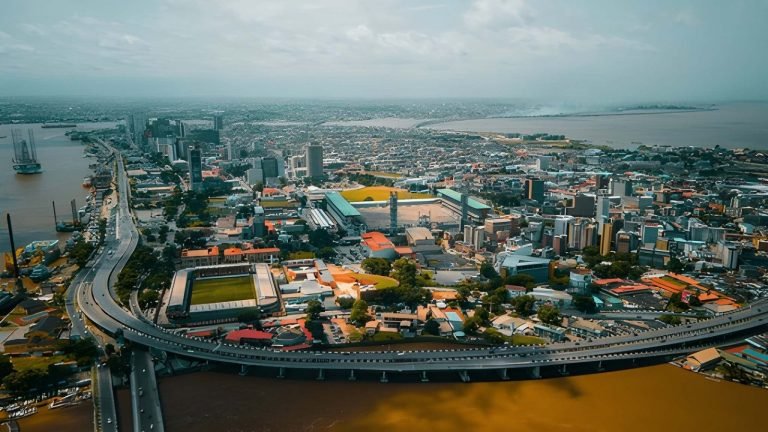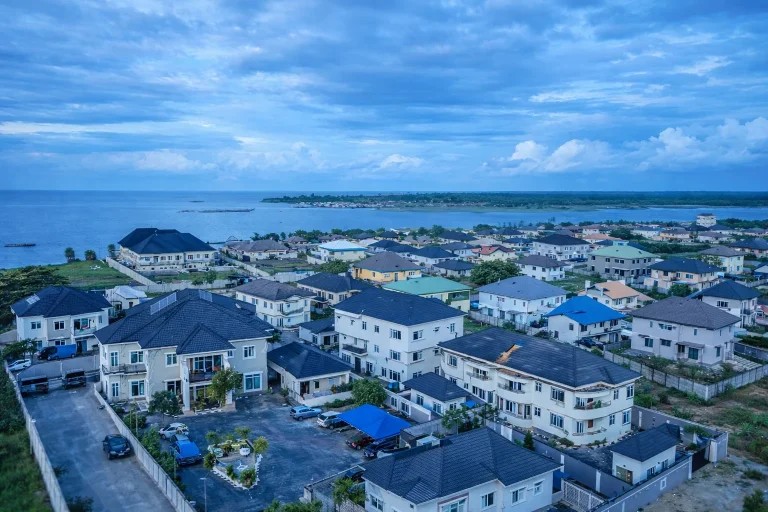
₦200,000 in Kebbi. ₦500 million in Banana Island.
That’s the price range for a single plot of land in the same country, in the same year. Nigeria’s land market isn’t one market — it’s dozens of micro-markets operating under radically different supply, demand, and infrastructure conditions.
If you’re trying to figure out how much a plot of land costs in Nigeria, the only honest answer is: it depends entirely on where. This article gives you the data for every major state and city, so you can stop guessing and start comparing.
All prices reflect Q1 2026 market conditions based on verified listing data from Nigeria Property Centre, PropertyPro, The Africanvestor, and Lexshield Properties.
Key Takeaways
- The price of a standard plot of land (approximately 648 sqm) in Nigeria ranges from ₦200,000 in rural Northern states to over ₦500 million in Lagos Island’s premium districts — a 2,500x spread.
- Lagos is Nigeria’s most expensive land market, with plots in Ibeju-Lekki starting at ₦15 million and Banana Island exceeding ₦500 million per plot.
- Ogun State offers the best value for Lagos-adjacent buyers — plots in Mowe and Magboro average ₦2–₦7 million, roughly 80% cheaper than comparable Lagos locations.
- Abuja plots range from ₦5 million in Lugbe to ₦350+ million in Maitama, depending on FCDA allocation status and district classification.
- Land prices nationally rose 18% in nominal naira terms from 2025 to 2026, but inflation-adjusted growth was closer to 0%–3%, meaning much of the “increase” reflects naira depreciation, not real value gains.
What Determines the Price of Land in Nigeria?
Before diving into the state-by-state data, you need to understand the five factors that drive land prices across the country. These explain why the same-sized plot can cost ₦2 million in one location and ₦200 million in another.
1. Location and Proximity to Economic Activity
Land near business districts, industrial zones, and employment hubs commands the highest premiums. A plot in Victoria Island (Lagos’s commercial heart) costs 100x more than a comparable plot in Epe — just 60km away — because VI generates economic activity that Epe does not yet match.
2. Title and Documentation Status
Land with a Certificate of Occupancy (C of O) or Governor’s Consent costs 30%–50% more than land with only a survey plan or family receipt. According to data from Nigeria Housing Market, buyers should budget an extra 10%–15% for title perfection beyond the purchase price.
3. Infrastructure
Roads, electricity, drainage, and water access directly impact land value. Plots in estates with paved roads and functioning infrastructure trade at 40%–100% premiums over plots on untarred roads with no services, even within the same local government area.
4. Supply and Demand Dynamics
Lagos has 22 million people competing for limited land on a narrow coastal strip. Kebbi State has abundant land and minimal urban demand. Basic economics drives the 2,500x price gap.
5. Speculation and Infrastructure Announcements
Government infrastructure projects create immediate price spikes. According to Nigeria Housing Market data, plots within 5km of the Lagos-Calabar Coastal Road saw 25%–40% appreciation after the $1.26 billion financing deal was announced in December 2025.
State-by-State Land Price Index: 2026
Here is the most comprehensive land price data available for Nigeria, covering 15 states and the FCT. All prices are for a standard residential plot (approximately 500–648 sqm) unless otherwise noted.
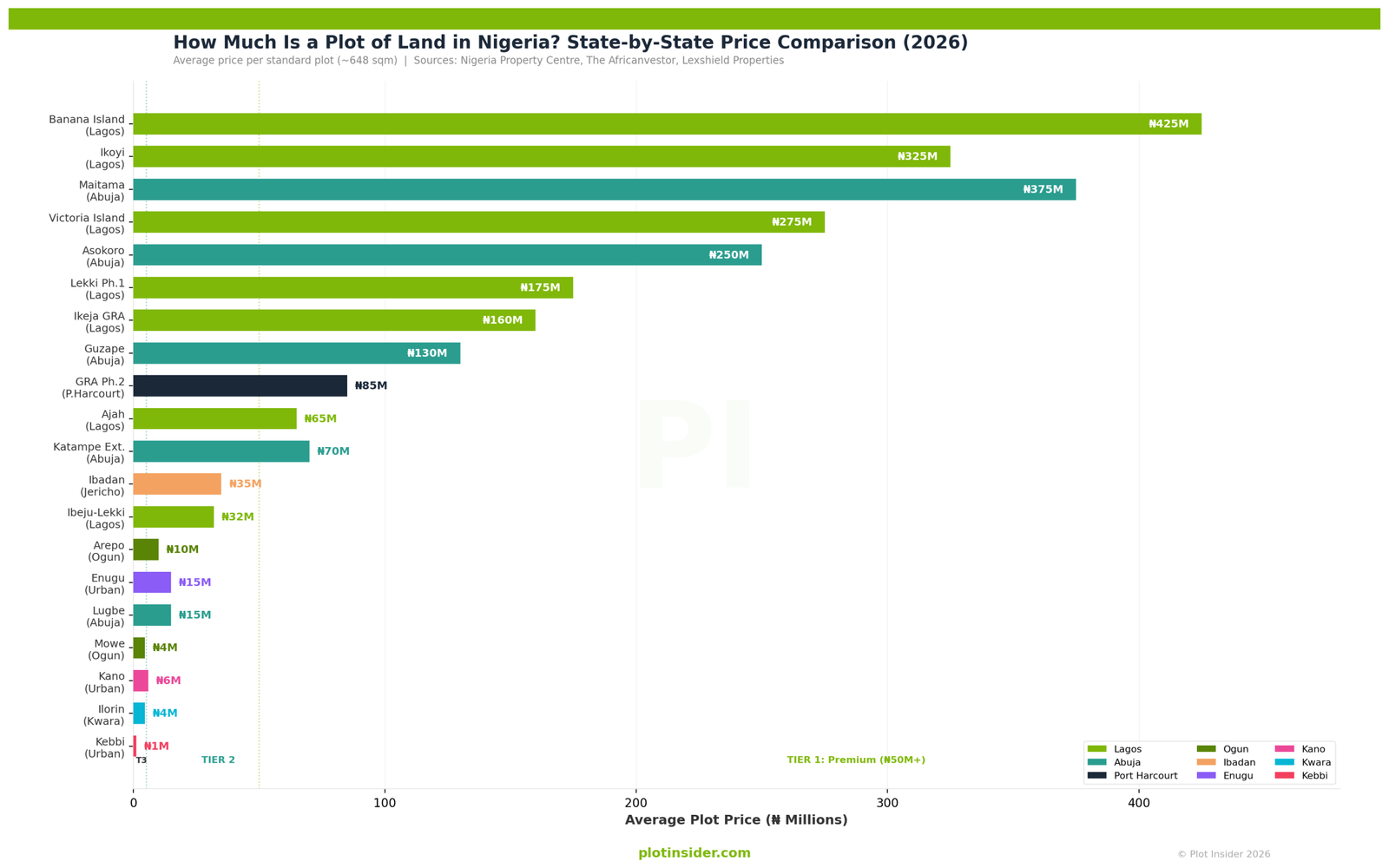
Lagos State — Nigeria’s Most Expensive Land Market
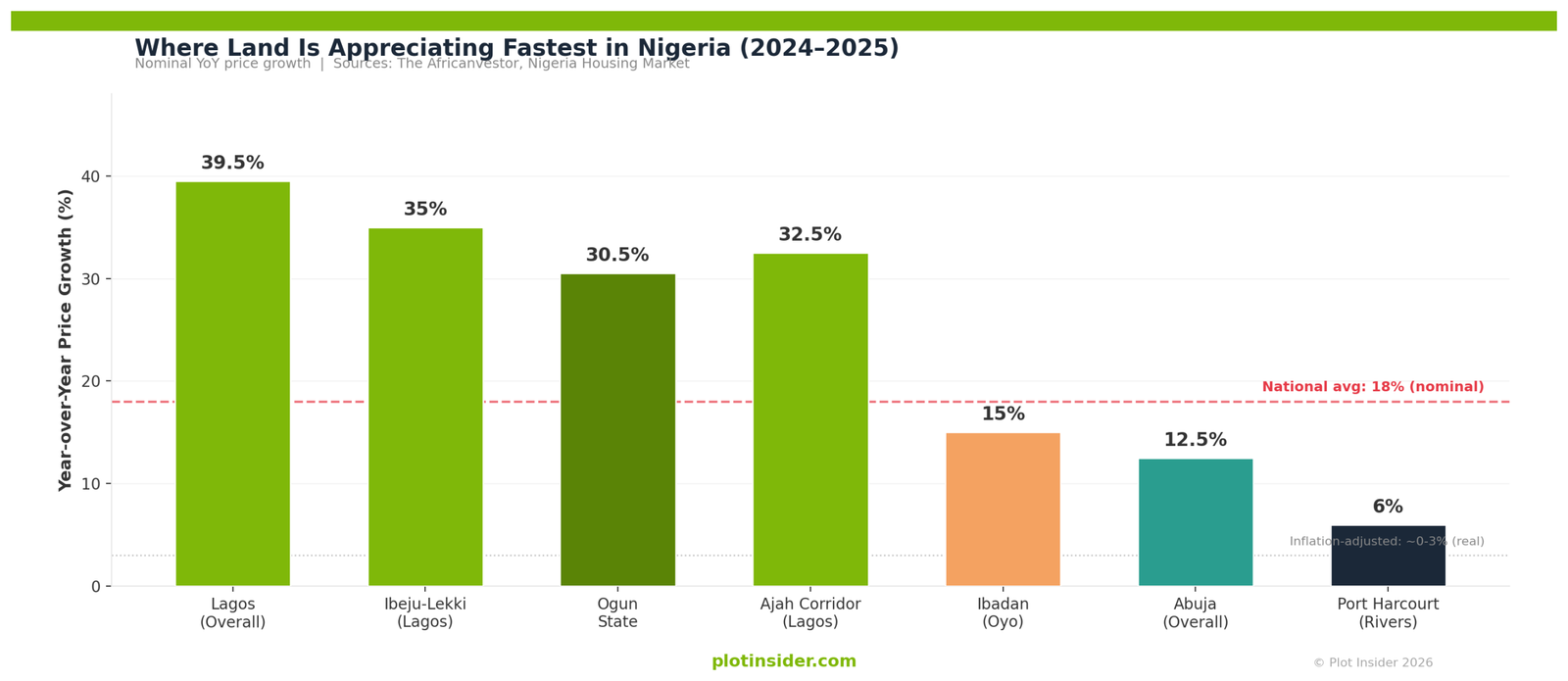
Lagos dominates Nigeria’s real estate market. According to The Africanvestor, Lagos property prices rose 39.5% in 2024, the highest of any state.
| Location | Price per Plot (₦) | Price per sqm (₦) | Title Type |
|---|---|---|---|
| Banana Island | ₦350M – ₦500M+ | ₦5M – ₦9M | C of O |
| Ikoyi (Old) | ₦200M – ₦450M | ₦2.5M – ₦6M | C of O |
| Victoria Island | ₦150M – ₦400M | ₦1.8M – ₦4M | C of O |
| Lekki Phase 1 | ₦100M – ₦250M | ₦1.5M – ₦3M | C of O / Gov. Consent |
| Ikeja GRA | ₦120M – ₦200M | ₦1.2M – ₦2M | C of O |
| Ajah (Abraham Adesanya) | ₦50M – ₦80M | ₦700K – ₦1.2M | Gov. Consent |
| Ajah (Sangotedo) | ₦20M – ₦45M | ₦400K – ₦700K | Gazette / Survey |
| Ibeju-Lekki | ₦15M – ₦50M | ₦250K – ₦500K | Gazette / C of O |
| Epe | ₦8M – ₦30M | ₦150K – ₦350K | Gazette / C of O |
| Ikorodu | ₦5M – ₦20M | ₦100K – ₦250K | Survey / Gazette |
| Badagry | ₦3M – ₦15M | ₦80K – ₦200K | Survey / Gazette |
Key insight: Ibeju-Lekki received ₦450 billion in private sector real estate investment in 2025 alone, according to the Lagos State Bureau of Statistics. This makes it the fastest-appreciating corridor — plots that cost ₦15 million in 2024 now command ₦25 million+.
Abuja (FCT) — Structured Market, Premium Pricing
Abuja’s land market is more regulated than Lagos due to the FCDA (Federal Capital Development Authority) allocation system. This creates clearer title documentation but also higher baseline costs.
| Location | Price per Plot (₦) | Price per sqm (₦) | Title Type |
|---|---|---|---|
| Maitama | ₦250M – ₦500M+ | ₦3M – ₦5.8M | FCDA Allocation |
| Asokoro | ₦150M – ₦350M | ₦2.5M – ₦4M | FCDA Allocation |
| Wuse 2 | ₦100M – ₦250M | ₦1.5M – ₦3M | FCDA Allocation |
| Guzape | ₦80M – ₦180M | ₦1.2M – ₦2.5M | FCDA Allocation |
| Katampe Extension | ₦40M – ₦100M | ₦600K – ₦1.5M | FCDA Allocation |
| Jahi | ₦30M – ₦80M | ₦500K – ₦1.2M | FCDA / R of O |
| Lugbe | ₦5M – ₦25M | ₦100K – ₦400K | R of O / Survey |
| Kubwa | ₦5M – ₦20M | ₦80K – ₦300K | R of O / Survey |
| Karsana | ₦8M – ₦30M | ₦150K – ₦450K | R of O / Allocation |
Key insight: Abuja recorded 10%–15% annual price growth in 2024–2025, according to The Africanvestor. Growth corridors like Karsana and Katampe Extension are attracting mid-market investors priced out of the city center.
Ogun State — Lagos Overflow, Budget Prices
Ogun is Nigeria’s value play — proximity to Lagos at a fraction of the cost. The state posted 30.5% property price growth in 2024.
| Location | Price per Plot (₦) | Key Driver |
|---|---|---|
| Mowe / Magboro | ₦2M – ₦7M | Lagos-Ibadan Expressway access |
| Otta / Sango | ₦3M – ₦10M | Industrial zone proximity |
| Arepo | ₦5M – ₦15M | Lagos boundary, estate development |
| Abeokuta (urban) | ₦3M – ₦12M | State capital, institutional presence |
| Ijebu-Ode | ₦1.5M – ₦5M | Developing town, university presence |
| Rural Ogun (farmland) | ₦500K – ₦2.5M | Agricultural use |
Key insight: An acre of farmland in rural Ogun costs ₦800,000–₦2.5 million — making it one of Nigeria’s cheapest agricultural land markets with direct road access to Lagos’s 22 million consumers, according to Lexshield Properties.
Rivers State (Port Harcourt) — Oil Capital Premium
| Location | Price per Plot (₦) | Key Driver |
|---|---|---|
| GRA Phase 2 | ₦50M – ₦120M | Premium residential, oil executive demand |
| Trans-Amadi | ₦30M – ₦80M | Industrial/commercial hub |
| Woji / Peter Odili Road | ₦20M – ₦60M | Mixed residential-commercial |
| Obigbo | ₦3M – ₦7M | Developing area, PH-Enugu expressway |
| Eleme | ₦2M – ₦8M | Industrial corridor, refinery proximity |
Oyo State (Ibadan) — Emerging Growth Market
Ibadan is recording 15% annual land appreciation driven by urban expansion and the Lagos-Ibadan Expressway.
| Location | Price per Plot (₦) | Key Driver |
|---|---|---|
| Bodija / UI Area | ₦15M – ₦40M | University belt, established residential |
| Jericho | ₦20M – ₦50M | Premium GRA, institutional proximity |
| Oluyole Estate | ₦10M – ₦25M | Gated estate, good infrastructure |
| Akala Express / Ring Road | ₦5M – ₦15M | Developing commercial corridor |
| Moniya / Ojoo | ₦2M – ₦7M | Peri-urban, expressway access |
| Akanran / Omi Adio | ₦800K – ₦3M | Rural fringe, farmland conversion |
Other States: Quick Reference Price Table
| State | City | Avg. Plot Price (₦) | Price Tier |
|---|---|---|---|
| Enugu | Enugu (urban) | ₦5M – ₦25M | Mid-range |
| Anambra | Awka / Onitsha | ₦3M – ₦15M | Mid-range |
| Delta | Asaba / Warri | ₦3M – ₦20M | Mid-range |
| Edo | Benin City | ₦3M – ₦15M | Mid-range |
| Kaduna | Kaduna (urban) | ₦2M – ₦12M | Affordable |
| Kano | Kano (urban) | ₦2M – ₦10M | Affordable |
| Kwara | Ilorin | ₦1M – ₦8M | Affordable |
| Ondo | Akure | ₦1.5M – ₦6M | Budget |
| Ekiti | Ado-Ekiti | ₦1M – ₦5M | Budget |
| Kebbi | Birnin Kebbi | ₦200K – ₦2M | Cheapest |
The 40x Rule: Understanding Nigeria’s Land Price Spectrum
To visualize how extreme Nigeria’s land price variation is, consider this: the most expensive plot in Lagos (Banana Island at ₦500M+) costs more than 2,500 times the cheapest plot in Kebbi State (₦200K). Even within Lagos alone, there’s a 100x gap between a plot in Badagry (₦3M) and Banana Island (₦300M+).
The data reveals three distinct pricing tiers across Nigeria:
Tier 1 — Premium (₦50M+ per plot): Lagos Island (Ikoyi, VI, Lekki Phase 1, Banana Island), Abuja Core (Maitama, Asokoro, Wuse 2), Port Harcourt GRA Phase 2. These markets are driven by scarcity, corporate demand, and dollar-denominated transactions.
Tier 2 — Mid-Market (₦5M–₦50M per plot): Lagos suburbs (Ajah, Ibeju-Lekki, Ikeja), Abuja growth corridors (Katampe, Jahi, Guzape), Ibadan premium, Enugu urban, Port Harcourt secondary. These are the most active investment zones where appreciation data is strongest.
Tier 3 — Affordable (₦200K–₦5M per plot): Ogun State (Mowe, Magboro), Lagos fringes (Badagry, deep Ikorodu), Northern cities (Kano, Kaduna, Kebbi), and most South-East/South-South towns. These markets offer the lowest entry points but typically slower appreciation unless triggered by new infrastructure.
Year-Over-Year Price Changes: Where Land Is Appreciating Fastest
Not all land is growing in value at the same rate. Here’s where the data shows the strongest appreciation in 2024–2025:
| Location | YoY Price Growth | Driver |
|---|---|---|
| Lagos (overall) | 39.5% (nominal) | Urbanization + infrastructure |
| Ogun State | 30.5% (nominal) | Lagos overflow demand |
| Ibeju-Lekki (Lagos) | 35%+ (nominal) | Coastal Road + Dangote + Port |
| Ajah corridor (Lagos) | 25%–40% | Fourth Mainland Bridge |
| Abuja (overall) | 10%–15% | High-end residential demand |
| Ibadan | 15% (land appreciation) | Urban expansion, expressway |
| Port Harcourt | 6% | Oil sector stability |
Source: The Africanvestor, Nigeria Housing Market
Important caveat: Nigerian property prices rose approximately 18% nationally in nominal naira terms from 2025 to 2026, according to The Africanvestor. However, after adjusting for inflation, real growth was close to 0%–3%. This means much of the “increase” reflects the naira losing purchasing power — not genuine value creation. Investors should track real (inflation-adjusted) returns, not just headline numbers.
How to Avoid Overpaying for Land in Nigeria
The price data above is a starting point — not a guarantee. Here are five data-backed rules for paying the right price:
Get 3 comparable prices before negotiating. Check the same area on Nigeria Property Centre, PropertyPro, and Jiji. If the seller’s price is 30%+ above the median, push back or walk away.
Verify the title before discussing price. A plot with a C of O should cost more than one with only a survey plan. If someone is selling “C of O land” at survey-plan prices, the documentation is likely incomplete or fraudulent.
Budget 10%–18% above the asking price for total costs. Stamp duty (1.5%–3%), legal fees (5%–10%), survey costs (₦50K–₦150K), and agency commission (5%–10%) add up fast. A ₦20 million plot can easily cost ₦24 million all-in.
Check for government acquisition. Some land is under government acquisition for infrastructure projects. If the government has acquired the land, your purchase has no legal standing. Verify at the state Land Registry before paying anything.
Visit during rainy season. Flood-prone land loses 20%–40% of its practical value because building costs increase and insurance becomes difficult. A plot that looks great in January might be underwater in July.
Conclusion
The question “how much is a plot of land in Nigeria?” doesn’t have one answer — it has hundreds. A plot in Kebbi costs less than a month’s rent in Lekki. A plot in Banana Island costs more than a fully built estate in Ibadan.
What the data shows clearly is this: Nigeria’s land market rewards informed buyers and punishes uninformed ones. The gap between the price you’re quoted and the price the data supports can be 20%–40% — and that gap is pure profit for whoever knows the numbers.
Plot Insider tracks land prices, infrastructure developments, and market data across Nigeria and Africa so you never walk into a negotiation blind. Explore our homepage for more data-driven intelligence, and read our guide on how many square meters is a plot of land to make sure you know exactly what you’re buying.
FAQs
What is the cheapest state to buy land in Nigeria?
Kebbi State has the lowest land prices in Nigeria, with plots available from ₦200,000 in semi-urban areas. Other affordable states include Ekiti (from ₦1 million in Ado-Ekiti), Kwara (from ₦1 million in Ilorin), and Ondo (from ₦1.5 million in Akure). However, cheaper land typically means less infrastructure, slower appreciation, and weaker resale demand.
How much is a plot of land in Lagos in 2026?
Lagos land prices range from ₦3 million in Badagry to over ₦500 million in Banana Island. The most active mid-market zone is the Ajah-Ibeju-Lekki corridor, where plots range from ₦15 million to ₦80 million depending on exact location and title status. Ibeju-Lekki is currently the fastest-appreciating corridor, driven by the Dangote Refinery, Lekki Deep Sea Port, and Lagos-Calabar Coastal Road.
How much is a plot of land in Abuja in 2026?
Abuja plots range from ₦5 million in Lugbe and Kubwa to over ₦500 million in Maitama. FCDA-allocated plots in prime districts (Maitama, Asokoro, Wuse 2) command the highest premiums. Growth corridors like Karsana, Katampe Extension, and Jahi offer mid-market entry points between ₦8 million and ₦100 million.
Is buying land in Nigeria a good investment?
Historically, yes. Over the past 10 years, Nigerian property prices increased roughly 300% in nominal naira terms, according to The Africanvestor. However, inflation-adjusted returns are closer to 35%–60%. The best returns come from buying in infrastructure-driven corridors (like Ibeju-Lekki) before major projects are completed, and holding for 5–10 years. Always verify title documentation and conduct independent surveys before purchasing.
Sources
- Nigeria Property Centre — Land Listings and Average Prices, 2026
- The Africanvestor — Nigeria Housing Prices and Average Property Prices, 2026
- Nigeria Housing Market — Lagos Property Prices and Nigeria Real Estate Forecast 2026
- Lexshield Properties — Complete Price Guide & Best Locations, 2026
- PropertyPro Nigeria — Land for Sale in Ogun and National Listings