
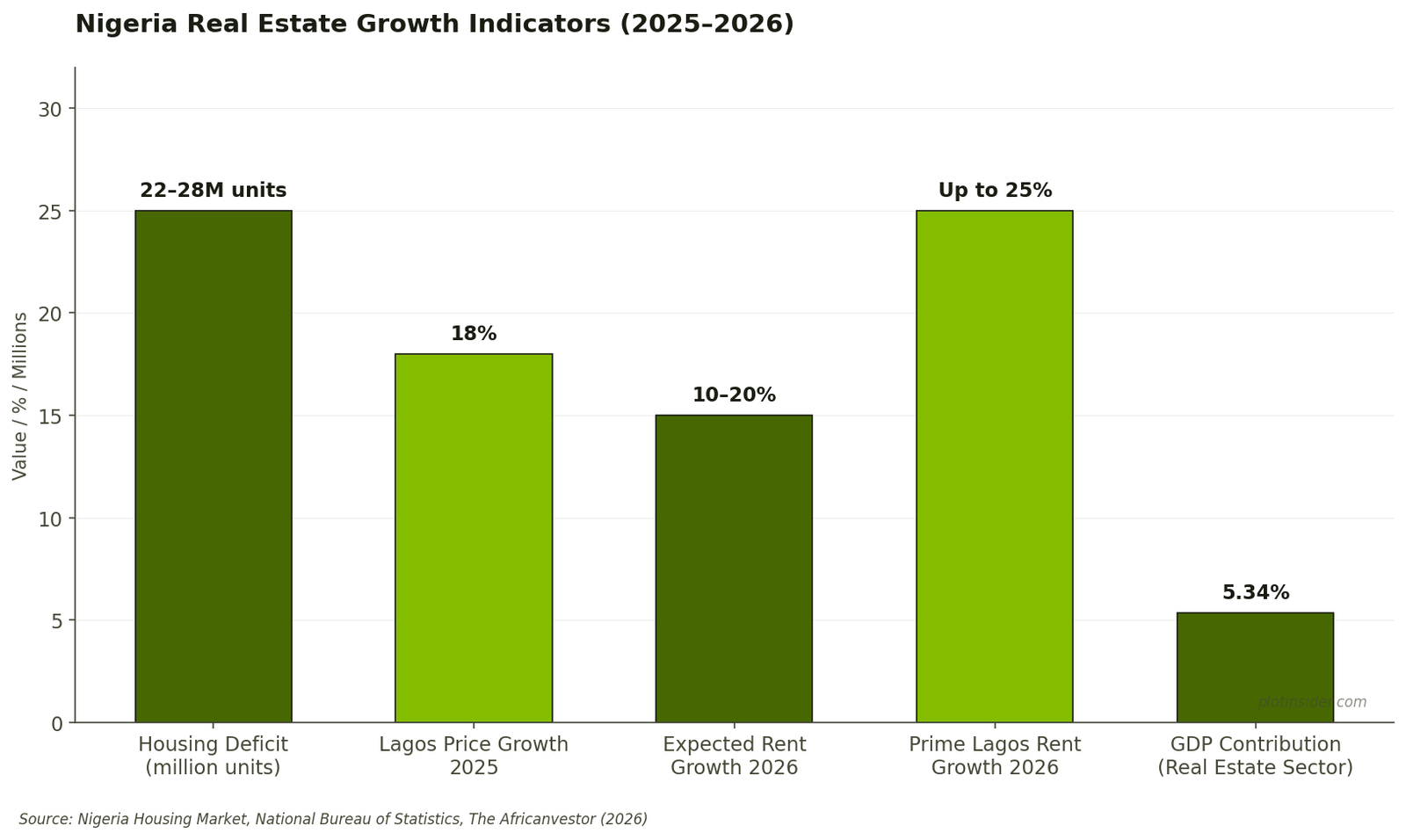
₦32.2 billion. That’s the current size of Nigeria’s real estate market, according to Next Move Strategy Consulting’s 2026 report. The sector contributed 5.34% to Nigeria’s real GDP in Q1 2022 — over $5 billion — and is still growing, despite a 22-million-unit housing deficit that Nigeria Housing Market estimates will take over 20 years to close.
That deficit is your opportunity. But starting a real estate business in Nigeria isn’t a matter of printing a business card and posting listings. You need legal registration, regulatory licensing, capital, and a defensible business model. Get any of those wrong and you’ll either hit a compliance wall or burn through your startup capital before your first closing.
This guide gives you the full data-backed roadmap: costs, timelines, regulatory requirements, and the five business models you can actually choose from.
Key Takeaways
- Total minimum startup cost to start a real estate business in Nigeria ranges from ₦500,000 to ₦2 million for a sole-proprietor agency, or ₦3 million to ₦10 million+ for an incorporated company
- CAC business name registration costs ₦10,500 (₦10,000 filing + ₦500 name search) as of May 2025 gazette
- ESVARBON license fees are ₦100,000 for individuals and ₦500,000 for corporate entities
- Real estate businesses are classified as Designated Non-Financial Institutions (DNFIs) and must register with SCUML under the EFCC
- Nigeria’s real estate sector grew 10.84% in Q1 2022 per the National Bureau of Statistics, contributing 5.34% to GDP
- Companies with foreign directors face a ₦10 million minimum share capital requirement
What Is a Real Estate Business in Nigeria?
A real estate business in Nigeria is any legally registered entity that deals in land, property sales, leasing, development, valuation, property management, or real estate brokerage — and is registered with the Corporate Affairs Commission (CAC) and, where applicable, the Estate Surveyors and Valuers Registration Board of Nigeria (ESVARBON).
Real estate businesses in Nigeria fall into five main categories:
- Real estate agency — buying, selling, and leasing on behalf of clients
- Property development — building residential or commercial properties from the ground up
- Property management — managing rental properties and short-let operations
- Estate surveying and valuation — professional valuation and consultancy (ESVARBON-licensed only)
- Real estate investment — land banking, flipping, and REIT-style holdings
Each category has different capital requirements, regulatory obligations, and profit timelines. Your choice determines your startup budget and your licensing path.
Why Real Estate Is Still a Viable Business in Nigeria (With Data)
Three fundamentals support Nigerian real estate as a viable business in 2026.
First, the housing deficit. Nigeria’s housing deficit is estimated between 22 and 28 million units, according to Nigeria Housing Market’s 2026 forecast. That gap won’t close in this generation — which means structural demand for housing, land, and property services.
Second, urbanization. Nigeria’s urban population is growing by roughly 4% per year. Lagos, Abuja, Port Harcourt, Ibadan, and Kano absorb the bulk of that migration — creating consistent pressure on rental and sales markets.
Third, price growth. Lagos property prices rose approximately 18% in naira terms in 2025. Abuja and Port Harcourt prime markets tracked close behind. Rent growth for 2026 is projected between 10–20% nationally, with prime Lagos submarkets potentially seeing 25% increases, according to The Africanvestor.
The 10-Step Process to Start a Real Estate Business in Nigeria
Step 1: Choose Your Business Model
Before spending a naira on registration, decide which of the five categories you’re entering. This single decision determines everything else — capital, licensing, team size, and timeline.
The table below compares startup capital by model.
| Business Model | Minimum Startup Capital | Licensing Required | Time to First Revenue |
|---|---|---|---|
| Real estate agency | ₦500k – ₦1.5M | ESVARBON optional | 1–3 months |
| Property management | ₦800k – ₦2M | ESVARBON preferred | 2–4 months |
| Short-let operations | ₦3M – ₦10M | CAC only | 1–2 months |
| Property development | ₦50M – ₦500M+ | REDAN + LASBCA | 12–36 months |
| Estate surveying & valuation | ₦2M – ₦5M | ESVARBON mandatory | 3–6 months |
Data compiled from AllenVest, Koriat Law, and Nigeria Housing Market, 2026.
Step 2: Register Your Business with CAC
Corporate Affairs Commission (CAC) registration is the non-negotiable first step. You have two main options:
Business Name — for sole proprietors and partnerships. Total cost is approximately ₦11,000 (₦10,000 filing + ₦1,000 name reservation) per the May 2025 CAC gazette. Processing takes 3–5 working days.
Private Limited Company (Ltd) — offers personal asset protection and increased credibility. CAC fee is ₦30,000 for a ₦100,000 share capital company, plus stamp duty of 0.75%. Total DIY cost: ₦30,000–35,000. With a CAC-accredited agent: ₦60,000–100,000. Processing takes 3–7 working days.
For real estate specifically, a Limited Liability Company is strongly recommended. The liability protection matters when you’re holding client deposits or entering property agreements.
Step 3: Register with SCUML (Mandatory for Real Estate)
The Special Control Unit Against Money Laundering (SCUML), a unit of the EFCC, classifies real estate companies as Designated Non-Financial Institutions (DNFIs). Registration is mandatory before commencing operations, according to Olamide Oyetayo Legal’s 2026 compliance guide.
SCUML registration is free but involves documentation and ongoing renewal. You must report high-value and suspicious transactions to SCUML in line with Nigeria’s Anti-Money Laundering laws.
Skipping SCUML is the single most common compliance mistake new Nigerian real estate entrepreneurs make.
Step 4: Register with FIRS for Tax
Upon CAC incorporation, a Tax Identification Number (TIN) is automatically assigned. But you still need to complete separate FIRS registration for tax purposes — including Value Added Tax (VAT) and Company Income Tax filings.
Required documents: application letter on company letterhead, Memorandum and Articles of Association, CAC certificate, and proof of company address.
Step 5: Obtain Your ESVARBON License (If Applicable)
If you’re operating as an estate surveyor or valuer, or want formal professional recognition, register with the Estate Surveyors and Valuers Registration Board of Nigeria (ESVARBON).
Current fees:
- Registration form: ₦26,000
- Interview and compliance: ₦70,000
- Individual license: ₦100,000
- Corporate license: ₦500,000
Source: Propsult Nigeria, 2026.
License validity is three years, renewable with a mandatory continuing-education course.
Step 6: Register with Professional Bodies (NIESV and REDAN)
The Nigerian Institution of Estate Surveyors and Valuers (NIESV) is the professional body for surveyors. The Real Estate Developers Association of Nigeria (REDAN) is the umbrella for property developers.
Both memberships provide credibility, networking, and access to industry resources. REDAN also serves as the contact point between private sector developers and government agencies.
Step 7: Secure Office Space and Basic Operations
Office rent in Nigeria ranges from ₦200,000 to ₦1 million annually, depending on location and size, per AllenVest’s 2025 analysis.
For a lean start:
- Victoria Island / Ikoyi Lagos: ₦800k–₦2M/year for a small serviced office
- Ikeja / Maryland Lagos: ₦400k–₦900k/year
- Wuse II / Maitama Abuja: ₦600k–₦1.5M/year
- Port Harcourt GRA: ₦500k–₦1.2M/year
Budget an additional ₦300k–₦800k for office furniture, internet, power backup, and basic IT setup.
Step 8: Build Your Digital Presence
A functional website and active social media are non-negotiable in 2026. Most Nigerian property searches now start on Google, Nigeria Property Centre, or PropertyPro.
Budget breakdown:
- Professional website: ₦150k–₦500k
- Domain and hosting (1 year): ₦25k–₦60k
- Initial Google Ads or Meta Ads budget: ₦200k–₦500k/month
Step 9: Acquire Initial Inventory or Partnership
There are two approaches to your first deals:
Agent/broker model — partner with existing property owners or developers and earn commissions (typically 5–10% of transaction value). Low capital, faster start.
Inventory model — buy land or property yourself to sell or lease. Capital-intensive but higher margin. Entry land banking deals in Ogun State start from ₦1 million per plot.
Most agents start with the broker model and transition to inventory over 2–3 years.
Step 10: File Annual Returns
Within 18 months of registration, you must file your first annual returns with CAC. Miss this window and penalties apply.
Annual returns cost approximately ₦3,000–₦5,000 for Business Names and ₦5,000–₦10,000+ for LLCs. Budget this into your compliance calendar.
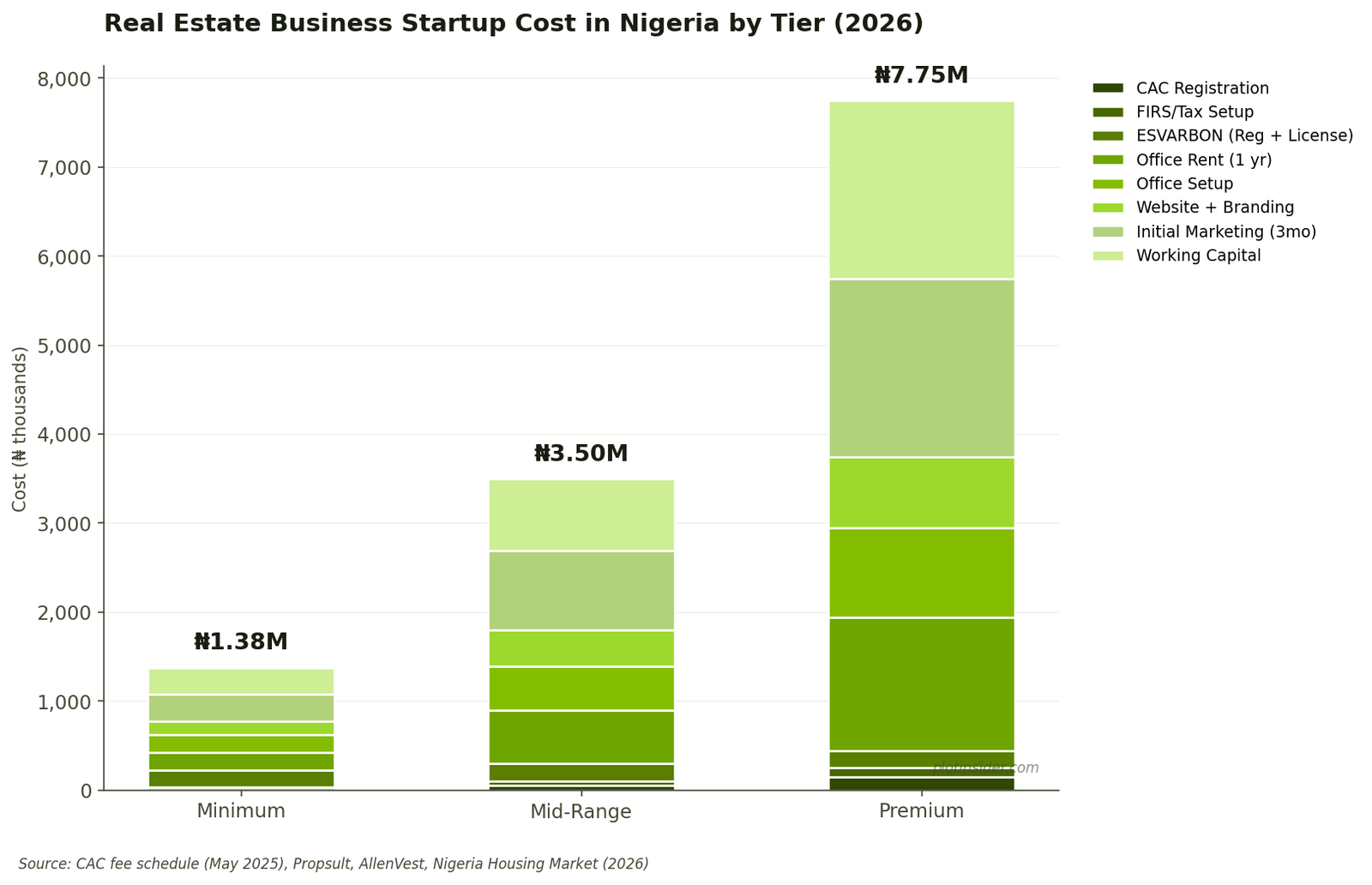
Total Startup Budget: Realistic 2026 Numbers
| Expense Category | Minimum (₦) | Mid-Range (₦) | Premium (₦) |
|---|---|---|---|
| CAC registration | 20,000 | 50,000 | 150,000 |
| SCUML registration | Free | Free | Free |
| FIRS/tax setup | 20,000 | 50,000 | 100,000 |
| ESVARBON license (individual) | 100,000 | 100,000 | 100,000 |
| ESVARBON registration + interview | 96,000 | 96,000 | 96,000 |
| Office rent (1 year) | 200,000 | 600,000 | 1,500,000 |
| Office setup | 200,000 | 500,000 | 1,000,000 |
| Website + branding | 150,000 | 400,000 | 800,000 |
| Initial marketing (3 months) | 300,000 | 900,000 | 2,000,000 |
| Working capital | 300,000 | 800,000 | 2,000,000 |
| Total | ₦1,377,000 | ₦3,496,000 | ₦7,746,000 |
Compiled from CAC official fee schedule (May 2025), Propsult, AllenVest, and Nigeria Housing Market 2026 data.
Common Mistakes When Starting a Real Estate Business in Nigeria
Three mistakes consistently derail first-year real estate businesses in Nigeria.
Skipping SCUML registration. Real estate is a DNFI under Nigeria’s Anti-Money Laundering Act. Operating without SCUML exposes you to EFCC enforcement and invalidates your banking relationships.
Underestimating compliance costs. Annual returns, tax filings, ESVARBON renewals, and NIESV dues add ₦200k–₦500k per year to your operating budget. Many new agencies forget these until penalties hit.
Starting without a niche. The agencies that survive year one pick a specific model (short-let management, commercial leasing, luxury resales) instead of trying to do everything. Focus wins.
For broader context on Nigerian real estate fundamentals, our guide on how real estate actually works in Nigeria breaks down the mechanics every new business owner should understand before committing capital.
Conclusion: Start With Data, Not Hype
Starting a real estate business in Nigeria in 2026 is genuinely viable — the 22-million-unit housing deficit and 10%+ sector growth rate make that clear. But viability isn’t the same as easy. You need ₦1.4–7.7 million to launch properly, the right CAC structure, mandatory SCUML registration, and a defensible business model.
The agencies that scale in Nigeria are the ones that treat real estate as a data-driven business: they know their market’s price-per-square-meter, they track comparable transactions, and they build around a specific niche instead of chasing every listing.
For ongoing market data, price benchmarks, and strategic analysis on Nigerian real estate, bookmark Plot Insider. We track the deals, the prices, and the policy shifts you need to run a defensible real estate business.
For a detailed view of how Nigerian property prices vary by state, see our state-by-state plot of land price index.
Frequently Asked Questions
How much does it cost to start a real estate business in Nigeria?
Starting a real estate business in Nigeria costs between ₦1.4 million and ₦7.7 million in 2026. This includes CAC registration (₦11,000–₦150,000), ESVARBON license (₦100,000 individual), office rent (₦200k–₦1.5M annually), marketing, and working capital. Sole-proprietor agencies can start closer to ₦500k if they skip the physical office.
Do I need a license to start a real estate business in Nigeria?
Yes. Real estate businesses in Nigeria must register with the Corporate Affairs Commission (CAC) and SCUML (under the EFCC). An ESVARBON license (₦100,000 for individuals, ₦500,000 for corporate entities) is mandatory for estate surveyors and strongly recommended for agencies operating at scale.
How profitable is the real estate business in Nigeria?
Nigerian real estate agents typically earn 5–10% commission on property transactions. An agent closing one ₦50 million deal per month generates ₦2.5–5 million in gross revenue. Property developers can earn 20–40% returns on successful projects, while short-let operators in Lagos averaged 24% net yields in Q1 2026, according to Nigeria Real Estate Blog.
What is the minimum share capital for a real estate company in Nigeria?
For Nigerian-owned real estate companies, there is no set minimum share capital, though ₦100,000 is standard. However, real estate companies with foreign directors or shareholders must meet a minimum share capital requirement of ₦10 million, according to Koriat Law’s 2026 compliance guide.
Sources
- CAC Registration Fees 2025 — Fbanabena & Co. https://www.fbanabena.com/cac-registration/cac-registration-fees/
- Setting Up a Real Estate Company in Nigeria — Koriat Law. https://koriatlaw.com/setting-up-a-real-estate-company-in-nigeria-requirements-costs-timelines/
- How to Start a Real Estate Business in Nigeria — AllenVest. https://allenvest.com/start-real-estate-business-nigeria/
- Nigeria Real Estate Forecast 2026 — Nigeria Housing Market. https://www.nigeriahousingmarket.com/market-forecasts/nigeria-real-estate-2026
- Real Estate Company Requirements — Olamide Oyetayo Legal. https://olamideoyetayolegal.com/starting-a-real-estate-company-in-nigeria-opportunitiesregulations-and-key-requirements/