₦28.5 million for a flat. ₦57 million for a duplex. Same country, same year — but two completely different property experiences.
Yet according to housing search data from Nigeria Property Centre, the majority of Nigerian property seekers use these terms interchangeably. They search for “apartments” when they mean flats, call terraced houses “duplexes,” and have never encountered the word “condominium” in a Nigerian context.
This confusion isn’t harmless. It leads to overpaying, buying the wrong property type for your goals, and misunderstanding what you actually own. This article uses real market data to define each housing type, compare their prices across Nigerian cities, and help you choose the right one based on evidence — not emotion.
Key Takeaways
- An apartment (flat) is a single unit within a multi-unit building — the most common housing type in Lagos and Abuja, making up 35% of urban property listings.
- A duplex is a two-storey self-contained residential building — Nigeria’s most aspirational housing type, available as fully detached, semi-detached, or terraced.
- A condo (condominium) is an ownership model, not a building type — you own the individual unit while sharing common areas with other owners under a management body.
- National average prices: 3-bedroom flat ₦28.5M, 4-bedroom duplex ₦57M, with Lagos and Abuja commanding 60–70% premiums above national averages.
- Your choice should be driven by budget, lifestyle, and investment goal — not social status. The data shows apartments deliver higher rental yields (5%–9%) while duplexes offer stronger long-term appreciation.
What Is an Apartment (Flat)?
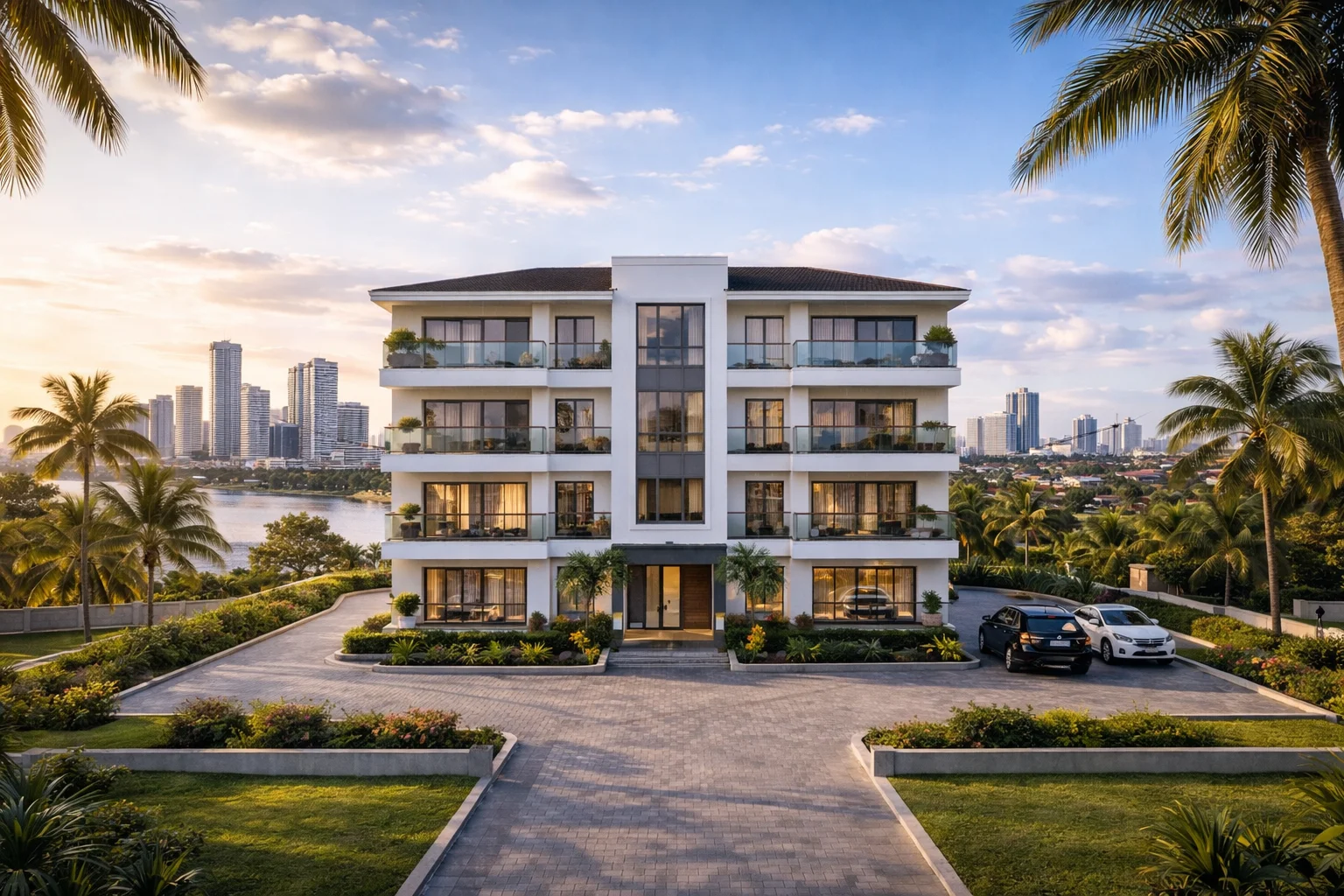
An apartment — commonly called a “flat” in Nigerian English — is a self-contained residential unit within a larger building that contains multiple units. Each unit typically has its own entrance, kitchen, bathroom, and living spaces, but shares the building’s structure, land, and common areas with other tenants.
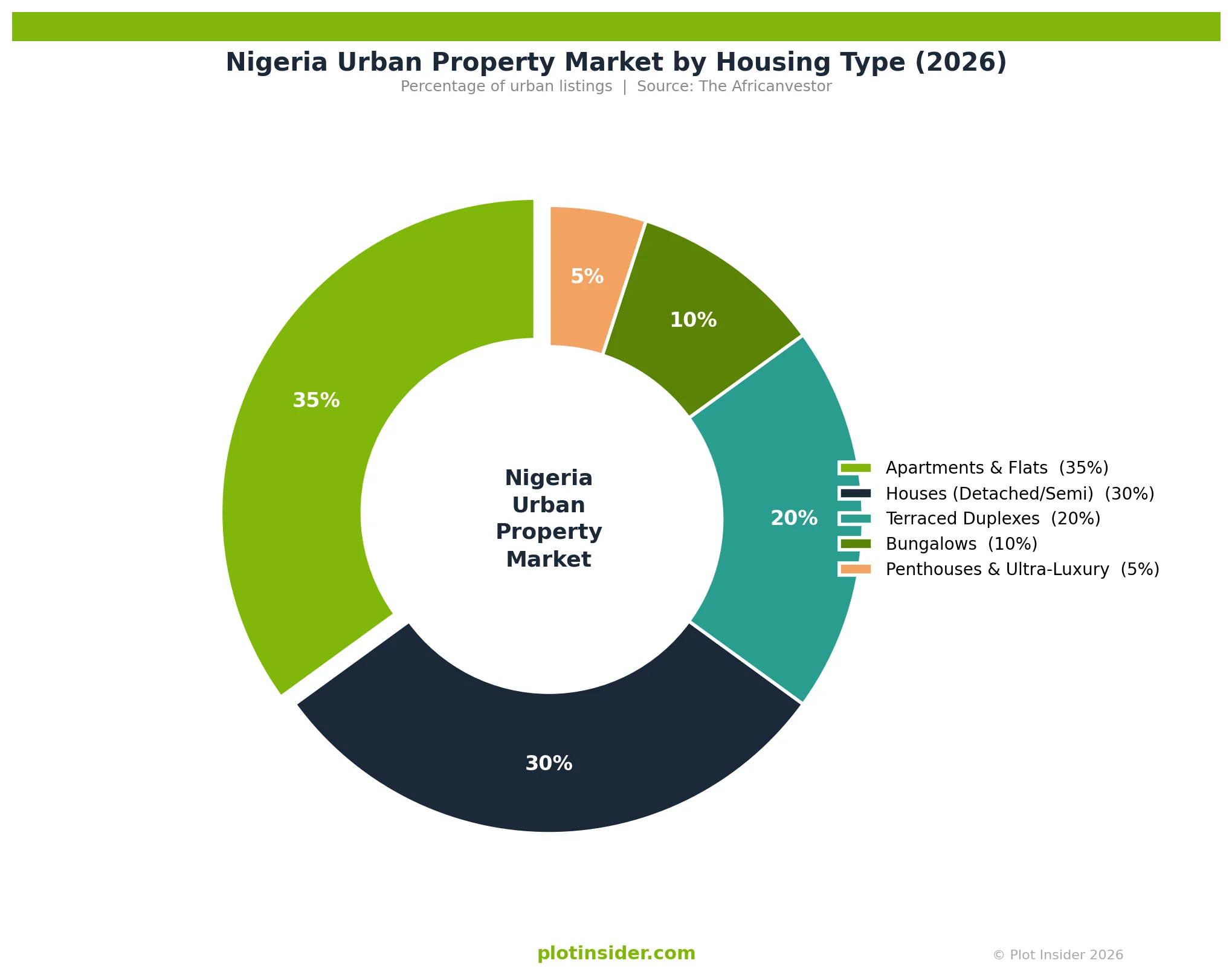
In Nigeria’s urban property market, flats and apartments account for approximately 35% of all listings, according to The Africanvestor’s 2026 housing analysis. This makes them the single most listed property type, closely followed by houses at 36%.
Key Characteristics of Apartments in Nigeria
- Ownership structure: You rent from a landlord who owns the entire building, or buy a unit where the developer retains ownership of common areas.
- Typical sizes: 1-bedroom (35–55 sqm), 2-bedroom (70–100 sqm), 3-bedroom (100–160 sqm).
- Common configurations: Block of flats (4–12 units), high-rise apartment (12+ floors, rare outside Lagos Island).
- Service charges: ₦500,000 to ₦3 million annually for serviced apartments, covering security, power, water, and estate maintenance.
Apartment Sub-Types You’ll Encounter
Self-contained / Studio — a single room with attached bathroom and kitchenette. Common in university towns and dense urban areas. Rent: ₦200,000–₦800,000/year.
Mini-flat — one bedroom, separate living room, kitchen, and bathroom. The entry-level apartment in Lagos and Abuja. Rent: ₦500,000–₦1.5 million/year.
Standard flat (2–3 bedroom) — the most common residential unit in Nigerian cities. This is what most people mean when they say “apartment.” Rent: ₦1.5 million–₦8 million/year depending on location.
Penthouse — top-floor luxury apartment with premium finishes, rooftop access, and panoramic views. Found primarily in Ikoyi, Victoria Island, and Eko Atlantic. Rent: ₦15 million–₦40 million/year.
What Is a Duplex?
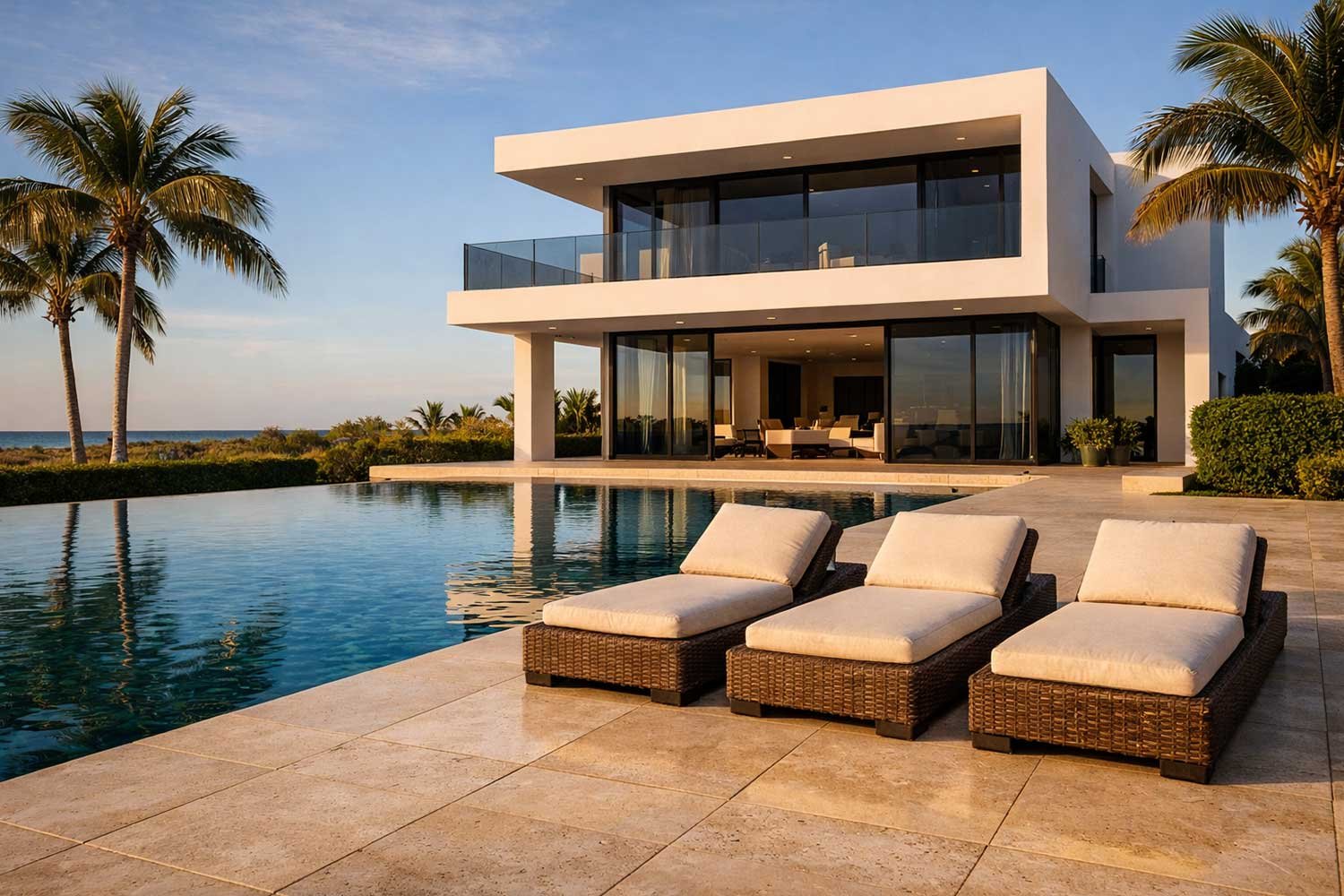
A duplex in Nigeria refers to a two-storey residential building designed as a single family home. This is different from the international definition — where a duplex means a building divided into two separate apartments. In the Nigerian market, “duplex” simply means “a house with two floors.”
Duplexes are Nigeria’s most aspirational housing type. They signal upward mobility, offer more space than apartments, and typically include features like a Boys’ Quarter (BQ), private parking, and a compound.
Types of Duplexes in Nigeria
Fully Detached Duplex — a standalone two-storey building on its own plot, not sharing any walls with neighboring properties. This is the premium tier. Prices range from ₦150 million in Ajah to over ₦3 billion in Banana Island, according to Nigeria Property Centre listings data.
Semi-Detached Duplex — shares one common wall with an adjacent unit. More affordable than fully detached, with prices typically 20%–30% lower for comparable size and location.
Terraced Duplex (Townhouse) — a row of attached duplexes sharing side walls with neighbors on both sides. The most affordable duplex format and extremely popular in Lagos estates. Prices range from ₦80 million in Ajah to ₦350 million in Lekki Phase 1.
| Duplex Type | Shared Walls | Privacy Level | Price vs Fully Detached |
|---|---|---|---|
| Fully Detached | None | Highest | Baseline (100%) |
| Semi-Detached | 1 wall | High | 70%–80% |
| Terraced | 2 walls | Moderate | 50%–65% |
What Is a Condo (Condominium)?
A condominium — or condo — is not a building type. It’s an ownership structure. When you buy a condo, you own your individual unit outright, while common areas (hallways, elevators, parking, pools, gardens) are jointly owned by all unit holders and managed by a property management association.
This model is standard in the US, Canada, and parts of Asia. In Nigeria, it’s emerging but still uncommon in its formal structure. Most Nigerian “luxury apartments” function as de facto condos — you buy the unit, pay service charges for common area maintenance — but without the formal condominium association framework that exists in mature markets.
How Condos Differ from Apartments
| Feature | Apartment (Flat) | Condo |
|---|---|---|
| Ownership | Typically rented from landlord | You own the individual unit |
| Common areas | Landlord’s responsibility | Jointly owned by all unit holders |
| Management | Landlord or facility manager | Condo association / management body |
| Service charge control | Landlord sets the rate | Owners vote on budget and rates |
| Resale | Not applicable (you don’t own it) | You can sell your unit independently |
| Legal framework | Standard tenancy law | Requires condominium registration |
In Lagos, developments like Eko Atlantic residences, select Ikoyi towers, and some Lekki Phase 1 high-rises operate closest to the condo model. Buyers purchase individual units and pay into a sinking fund managed by a residents’ association.
The critical thing to understand: in Nigeria, when a developer says “luxury apartment for sale,” they usually mean a condo-style arrangement — you’re buying ownership of a unit. When they say “apartment for rent,” it’s a traditional flat. The language is imprecise, so always confirm the ownership structure in the sales agreement.
Price Comparison: Apartment vs Duplex vs Condo Across Nigeria
This is where the data matters most. Here’s how pricing compares across Nigeria’s major cities as of early 2026.
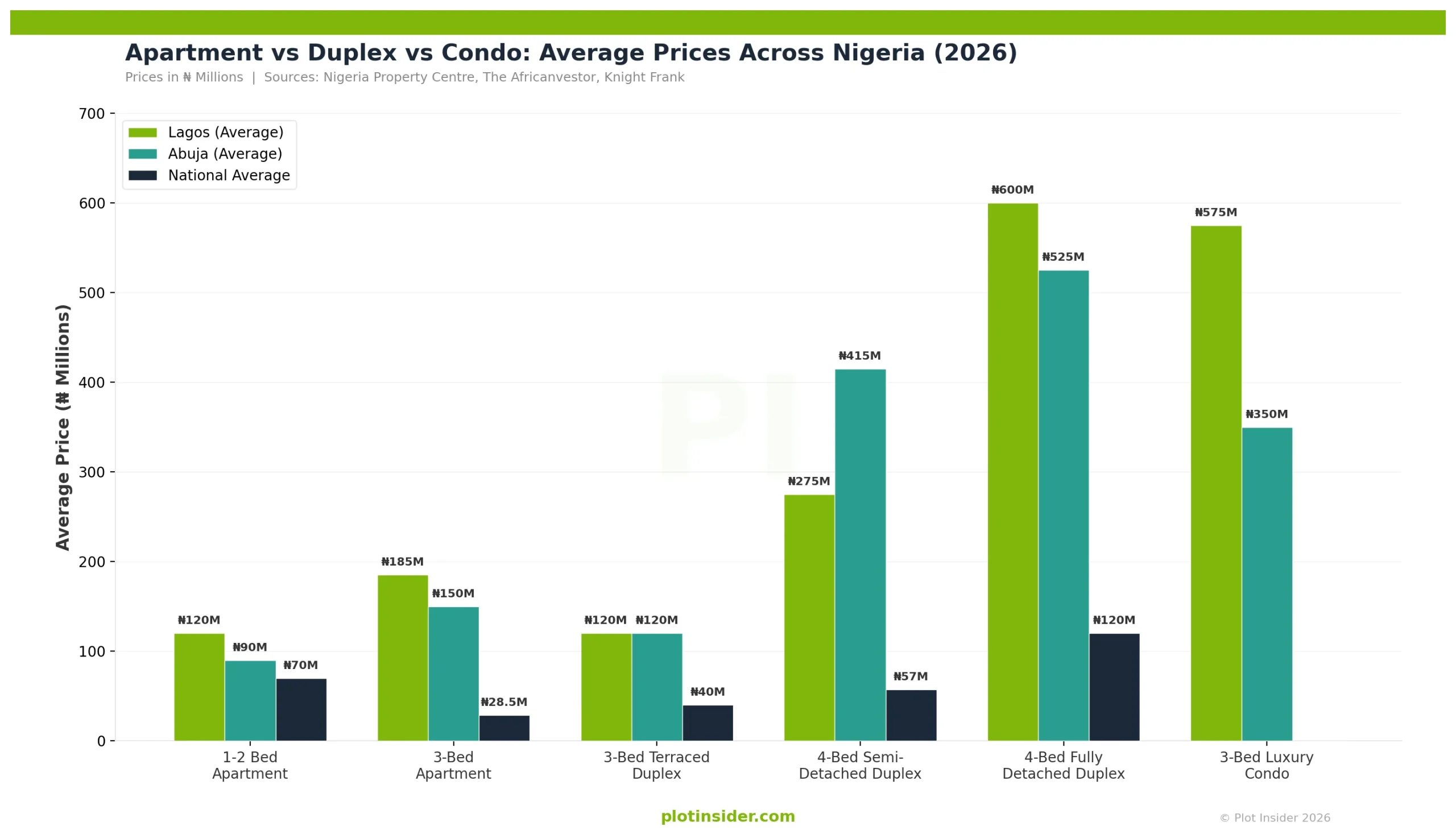
National Average Prices by Property Type
According to data from The Africanvestor and Nigeria Property Centre:
| Property Type | National Average | Lagos Average | Abuja Average |
|---|---|---|---|
| 1–2 bed apartment | ₦70M | ₦90M–₦150M | ₦60M–₦120M |
| 3-bed apartment | ₦28.5M (national) / ₦160M (Lagos prime) | ₦120M–₦250M (Island) | ₦120M–₦180M |
| 3-bed terraced duplex | ₦35M–₦45M (national) | ₦80M–₦160M | ₦90M–₦150M |
| 4-bed semi-detached duplex | ₦57M (national avg) / ₦320M (Abuja prime) | ₦150M–₦400M | ₦180M–₦650M |
| 4-bed fully detached duplex | — | ₦250M–₦1.2B+ | ₦250M–₦800M |
| Condo unit (luxury, 3-bed) | — | ₦250M–₦900M (VI/Ikoyi) | ₦200M–₦500M (Maitama) |
Note: National averages reflect all cities including smaller markets. Lagos and Abuja prices are 60–70% above national averages.
Price Per Square Meter Comparison
The price per sqm reveals the true cost of each property type, stripping away the size variable:
| Property Type | Price/sqm (Lagos Mainland) | Price/sqm (Lagos Island) | Price/sqm (Abuja Prime) |
|---|---|---|---|
| Apartment / Flat | ₦400K–₦800K | ₦1.5M–₦4M | ₦1M–₦3.3M |
| Terraced Duplex | ₦350K–₦700K | ₦1.2M–₦2.5M | ₦800K–₦2M |
| Detached Duplex | ₦300K–₦600K | ₦1M–₦3M | ₦800K–₦2.5M |
| Luxury Condo | — | ₦2.5M–₦6M | ₦2.8M–₦5.8M |
Sources: The Africanvestor, Jarniascyril Nigeria Real Estate, Knight Frank Nigeria H1 2025 Report
The data reveals an interesting pattern: apartments actually cost more per square meter than duplexes in most locations. This is because apartments in prime areas include premium services (elevators, generators, security, swimming pools) that are factored into the unit price. Duplexes spread their cost over a larger footprint, lowering the per-sqm figure.
Rental Yields: Which Property Type Earns More?
For investors, the question isn’t just “which costs less” — it’s “which earns more relative to what I paid?”
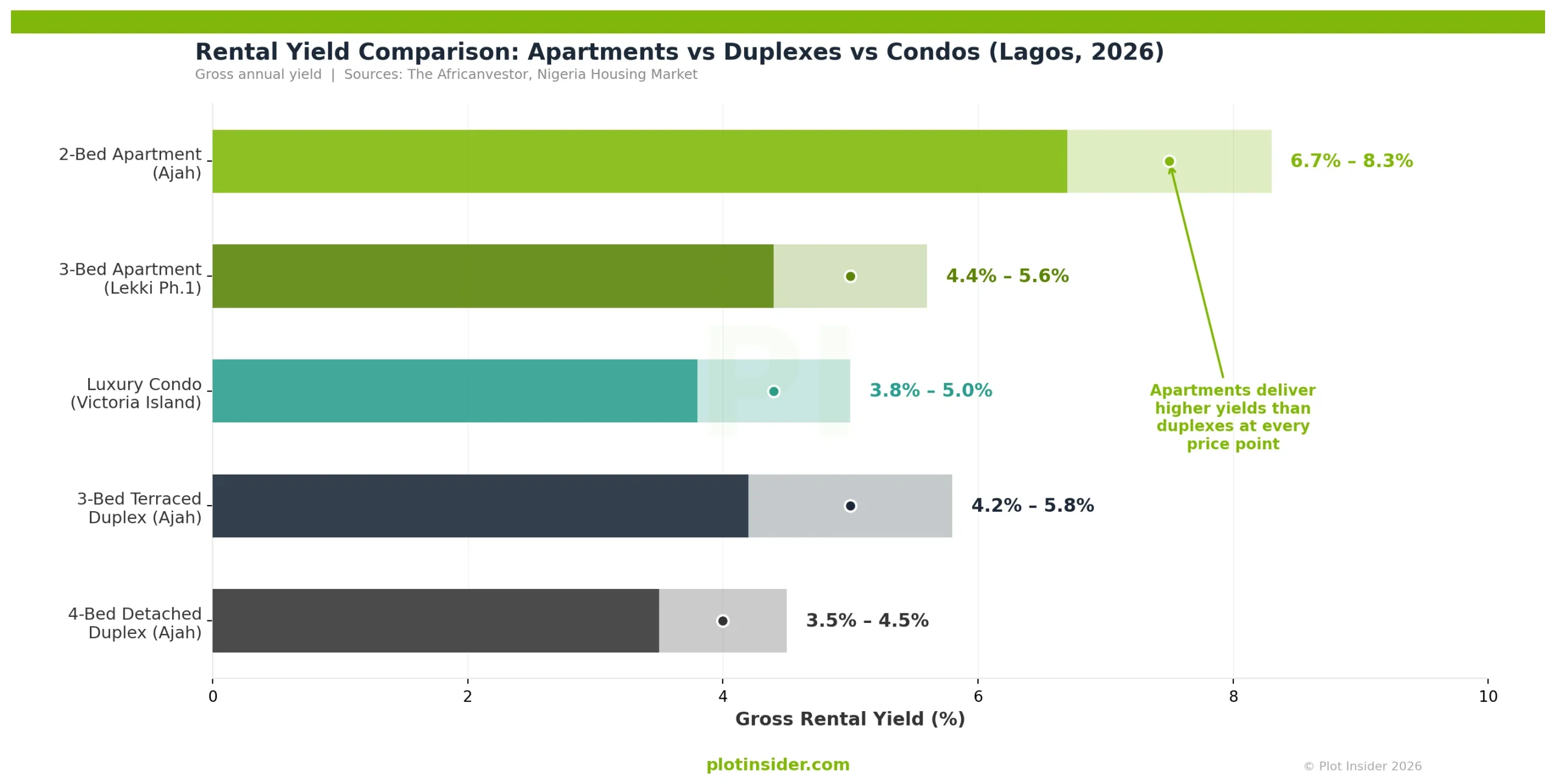
| Property Type | Purchase Price (Lagos Mid-Market) | Annual Rent | Gross Yield |
|---|---|---|---|
| 2-bed apartment (Ajah) | ₦60M | ₦4M–₦5M | 6.7%–8.3% |
| 3-bed apartment (Lekki Phase 1) | ₦180M | ₦8M–₦10M | 4.4%–5.6% |
| 3-bed terraced duplex (Ajah) | ₦120M | ₦5M–₦7M | 4.2%–5.8% |
| 4-bed detached duplex (Ajah) | ₦200M | ₦7M–₦9M | 3.5%–4.5% |
| Luxury condo (Victoria Island) | ₦400M | ₦15M–₦20M | 3.8%–5.0% |
Source: Rental yield estimates compiled from The Africanvestor and Nigeria Housing Market
The verdict: Apartments consistently deliver higher rental yields than duplexes, particularly in the mid-market segment. A 2-bedroom flat in Ajah generates 6.7%–8.3% gross yield — nearly double what a detached duplex in the same area returns. This is because apartments have lower purchase prices relative to rental demand, especially in areas with high populations of young professionals and small families.
However, duplexes outperform on long-term appreciation. According to Nigeria Housing Market data, detached duplexes in established estates appreciated 15%–25% annually in prime corridors, compared to 10%–15% for apartments — because land value (which duplexes capture more of) grows faster than building value.
How to Choose: Decision Framework
Your choice between apartment, duplex, and condo should be driven by three factors — not social pressure.
Choose an Apartment If:
- Your budget is under ₦100 million in Lagos or ₦80 million in Abuja.
- You want maximum rental yield as an investor (6%–9%).
- You’re a young professional or small family prioritizing location over space.
- You prefer low-maintenance living with services included.
Choose a Duplex If:
- You need 4+ bedrooms and dedicated family space.
- Long-term appreciation is your primary investment goal.
- You want a compound with private parking and BQ.
- You plan to live in the property for 10+ years.
Choose a Condo If:
- You want to own (not rent) a unit in a premium managed building.
- You value amenities: gym, pool, concierge, elevator.
- You’re a diaspora buyer who needs professional management while abroad.
- You understand the legal structure and are comfortable with service charge governance.
The Ownership Trap: What Most Buyers Get Wrong
There’s a critical legal distinction that catches Nigerian buyers off guard.
When you buy a “flat” in a Block of 6, you might think you own your unit. But if the developer sold you a Deed of Assignment for the unit without registering a formal strata title or condominium structure, what you actually own is a share of the building — not a legally independent unit.
This means:
- You can’t sell your unit independently without the developer’s or other owners’ cooperation.
- There’s no legal framework governing how common area costs are split.
- If one owner defaults on maintenance, all owners suffer.
Before purchasing any apartment or condo-style unit, confirm with your lawyer whether the development has:
- Individual unit titles — each unit has its own C of O or registered Deed.
- A registered management corporation — governing common areas and service charges.
- A clear sinking fund structure — for long-term maintenance like elevator replacement and structural repairs.
Without these three elements, you’re buying into a legal gray zone regardless of how beautiful the building looks.
Building Cost Comparison: What It Costs to Build Each Type
For those considering construction rather than buying finished properties, here’s what the data shows for building costs in Nigeria as of 2025–2026.
| Property Type | Typical Size | Build Cost (Standard Finish) | Build Cost (Luxury Finish) |
|---|---|---|---|
| 2-bed apartment (in a 4-unit block) | 80–100 sqm | ₦18M–₦25M per unit | ₦30M–₦45M per unit |
| 3-bed terraced duplex | 150–200 sqm | ₦35M–₦55M | ₦60M–₦90M |
| 4-bed semi-detached duplex | 200–280 sqm | ₦50M–₦80M | ₦90M–₦150M |
| 5-bed fully detached duplex | 300–400 sqm | ₦80M–₦130M | ₦150M–₦300M+ |
Sources: Structville Construction Cost Guide, Nigerian Queries Building Cost Report
These figures exclude land cost, which varies dramatically. A plot in Ajah (₦20M–₦80M) versus a plot in Ikoyi (₦500M–₦1.5B) can make the same building project cost 5x more simply because of location.
Construction timelines range from 3–6 months for standard builds to 12–18 months for luxury specifications, according to Structville. Delays caused by funding gaps are the most common issue — nearly every self-funded project in Nigeria pauses at least once during construction.
Conclusion
The data doesn’t care about what sounds prestigious. A 2-bedroom apartment in Ajah at 7%+ rental yield is objectively a better income investment than a 4-bedroom duplex in the same area at 4% yield. But if your goal is long-term wealth building through appreciation, the duplex wins.
Understanding the difference between these housing types — and more importantly, their ownership structures, price mechanics, and yield profiles — is the foundation of every smart real estate decision in Nigeria.
Plot Insider exists to replace confusion with data. Whether you’re choosing between an apartment and a duplex, comparing neighborhoods, or evaluating an entire city’s property market, we put the numbers in your hands first. Explore more data-driven analysis on our homepage and read our complete guide to how real estate works in Nigeria.
FAQs
Is a duplex better than a flat in Nigeria?
It depends on your goal. Flats deliver higher rental yields (6%–9% in emerging areas) and cost less upfront. Duplexes offer more space, stronger long-term appreciation (15%–25% annually in prime corridors), and higher social prestige. For rental income, data favors apartments. For family living and wealth building over 10+ years, duplexes outperform.
What is the cheapest type of house to buy in Nigeria?
A mini-flat (1-bedroom apartment) is the most affordable entry point, with prices starting from ₦18 million in areas like Ajah and Ikorodu. For buyers who want more space, a 2-bedroom flat in a developing area can be found for ₦35–₦60 million. Terraced duplexes are the cheapest duplex format, starting around ₦80 million in Lagos suburbs.
Are condos available in Nigeria?
Formal condominium structures are still emerging in Nigeria. However, many luxury apartment developments in Ikoyi, Victoria Island, Eko Atlantic, and Maitama operate on a condo-like model — you buy the unit, share common area ownership, and pay service charges to a management body. Always verify the legal ownership structure with your lawyer before purchasing.
What is the difference between a terraced house and a duplex?
In Nigerian real estate, a terraced house (townhouse) is a type of duplex — specifically, a two-storey home that shares walls with adjacent units on both sides. A “duplex” in Nigeria broadly refers to any two-storey residential building, whether fully detached (no shared walls), semi-detached (one shared wall), or terraced (two shared walls). Terraced duplexes cost 35%–50% less than fully detached duplexes for comparable size and location.
Sources
- The Africanvestor — Nigeria Housing Prices 2026
- The Africanvestor — Average Property Price in Nigeria
- Nigeria Property Centre — Average Prices Market Trends
- Structville — Cost of Duplex Construction in Nigeria
- Jarniascyril — Nigeria Real Estate Price Comparison